Conversations in dark times

Sometime in the middle of September, I was enjoying dinner out with friends but having trouble hearing the conversations around the table. But one voice was pitched at just the right register. That was Deborah Schnieder’s—someone I just knew casually. I don’t know how we got to talking about Ukraine, but when we did, other conversations ensued.

I had learned a bit about post-war Ukraine when I was teaching in Poland. I knew that their respective borders shifted after World War II when eastern Poland became western Ukraine. In fact, Ukraine has endured periods of Polonization and Russification for over three centuries. That evening Deborah gave me a more present tense perspective.

She told me that she volunteers with an organization called ENGin (https://app.enginprogram.org/#/home). It’s a non-profit which matches Ukrainians with English speakers—not people of Ukrainian descent in the U.S. but citizens in and of Ukraine. The program is designed to help participants improve their English through weekly Zoom calls—a 21st-century form of pen pals. But when Deborah told me that she’s been talking with her ENGin partner in Kyiv for more than two years (often hearing drones in the background), it was clear this wasn’t simply a matter of language coaching. Becoming involved with ENGin involved personal encounters and the potential for friendships with individuals living with the consequences of war.  
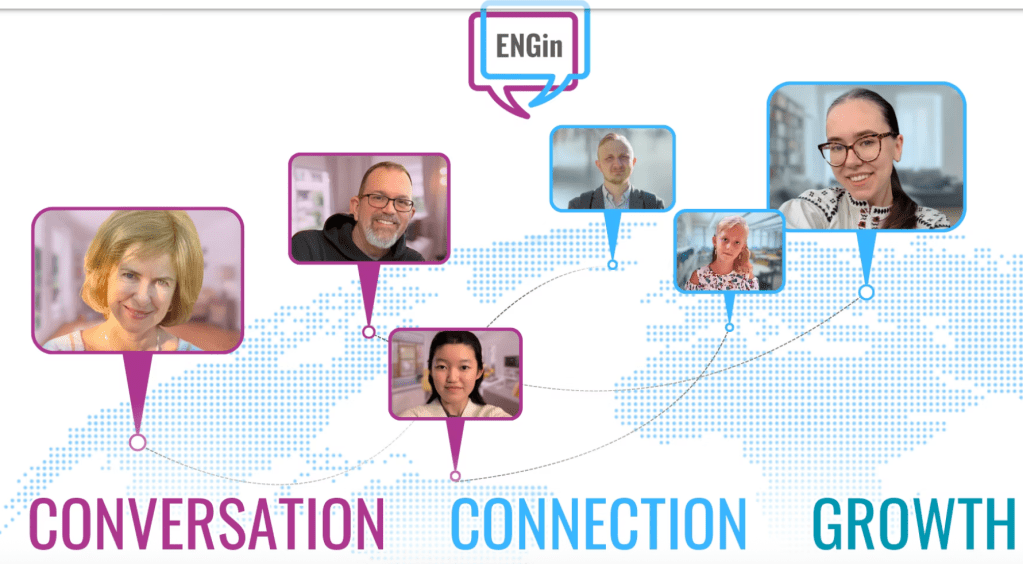
 After that dinner Deborah introduced me to another volunteer, Mary Sheerin, a 91-year-old life-long activist and educator. We met up at Mary’s house because I wanted to learn more about ENGin’s program while I was waiting to be assigned my own partner.  I was especially curious about why they got involved, given that Ukraine is so far away (psychologically and geographically) from upstate New York and the conflict doesn’t really affect their daily lives. Or does it? As philosopher Kwame Anthony Appiah points out in his book Cosmopolitanism, today we encounter more people than our ancient ancestors would have met in a single day. He argues that in addition to having responsibilities to our ‘kith and kin,’ we also have responsibilities to those who we know of through our virtual lives. While tacitly embracing Appiah’s global notion of ethics, Deborah and Mary also had a more pragmatic answer to my question: why care? They both see Ukraine as the frontline in the fight for democracy against a rapacious Russia (a.k.a., Vladimir Putin). They both recognize that the conflict could lead to NATO’s involvement, which would mean our involvement. So maybe not so far away after all. 

In any case, ‘far away’ is relative in cyberspace. Mary’s Zoom partner Viktoriia is originally from Kyiv. She is a 25-year-old web designer who is currently living in Munich with her mother. They moved after the house next to theirs was bombed. She’s largely apolitical and doesn’t want to talk about the war at all.  Instead, she is more preoccupied with her social life within Munich’s tight-knit Ukrainian community and tells Mary she’s having fun. (What 25-year-old doesn’t want to have fun?) Viktoriia is glad to be in Germany where support is generous, including free language lessons, four hours a day. She and Mary tend to talk while Viktoriia is walking around the city, one Mary is familiar with, so they have that in common, as well as the pleasure of conversation.

Deborah’s partner Eliza has been more peripatetic. When the war began, she moved from Kharkiv (a city near the Russian border regularly under siege) to Poland and then back to Kyiv where she works remotely for Nestle as a user experience designer. Deborah says they do talk about the war because it’s ever-present in Kyiv. Eliza, who is 34, follows the politics of Ukraine and the U.S.—as you would if bombings were a regular feature of daily life. She lives on the 19th floor of a high rise building where the electricity goes out and elevators stop running during air raids. (In fact, she and Deborah haven’t been able to connect much at all lately as her internet is often down due to the uptick in Russian attacks.) So naturally Eliza is deeply disappointed by U.S. vacillations on its support, not to mention its recent betrayals during peace negotiations. For all that, Deborah describes her as resilient and upbeat. In addition to talking about how she copes physically and emotionally, they also talk about her love of dogs and her tango lessons. Well-traveled—she took a vacation to Greece last year—Eliza enjoys her independence even though she’s considered a bit odd for living alone. She suffers the stigma of being unmarried at her age. Her self-consciousness of her single status, as much as her stories of the pleasures of daily life, is a reminder that being Ukrainian isn’t synonymous with being a victim of war.

Shortly after meeting with Mary and Deborah, I was connected with Olha (Ukrainian for Olga), a 41-year-old woman who left Ukraine for Romania with her husband and two daughters, aged 7 and 12. Like Viktoriia, Olha left in 2022 when a house next door was destroyed.  (They chose Romania because they can occasionally make the 12-hour drive back to see family who have stayed behind in Kharkiv.) When she first arrived, Olha worked with a humanitarian agency helping displaced fellow Ukrainians; but listening to them talk about the atrocities they witnessed and suffered, especially in Bucha, took its toll. (She’s since left that job.) Now adrift with no career prospects in sight, she’s putting her energies into learning Romanian, a romance language with few words in common with her own. This is a different kind of courage that we often underestimate, taking it for granted (and often demanding) that immigrants should write and speak in their new countries’ languages, all the while they deal with the trauma of displacement. It’s hard to comprehend without talking to someone who is going through that transition; just as it’s impossible to come close to understanding the realities of staying put without hearing about it first-hand. 

Nora Krug’s War Stories, pp. 104-105

It is easy to underestimate the value of small conversations in the face of the current avalanche of dispiriting news from Ukraine and elsewhere. Which isn’t to say that these conversations aren’t sometimes fraught, as I’m finding with Olha. After our initial Zoom, which was largely an exchange of pleasantries, I sent Olha scans of a couple of pages from a book (Nora Krug’s War Diaries) about the experiences of an artist who flees Russia because he feared Putin’s persecution and a Ukrainian journalist who commutes between Ukraine and Denmark (where her children live with their grandmother). I quickly learned that sharing my scant knowledge of the conflict (meant as sign of interest in her world) wasn’t helpful to Olha. This isn’t an abstract issue to be read about in a book. She didn’t want to hear these stories, especially any that had Russian protagonists.

Since then, we’ve spoken several more times, largely about our families, daily routines, and, more recently, holiday rituals. Somehow Easter survived the communist era’s disdain for religion. Christmas, however, took a hit, leaving Olha with few traditions and feeling estranged from the festivities around her in Romania. (She lives in the country’s second largest city Cluj-Napoca, which is fairly cosmopolitan.) The one time we touched on the war was when she told me that her 17-year-old nephew was leaving Ukraine to live with her to avoid the draft. When I asked how that might work out, Olha said he was happy to come. In any case, he has no friends his age in Kharkiv, as most boys had been sent out of the country long ago.

Even more valuable than the particulars of our conversations is the fact that, over time, they pierce the numbness created by one headline after another and the nightly doses of war pornography that I see on television. For both of us, they offer a time for confidences of a purely personal nature whether it be about family members, hair styles, or house plants. Olha’s status as a ‘refugee’ is, if not irrelevant, then too reductive. 

Our conversations put me in mind of an essay by the Croatian journalist, novelist, and essayist Slavenka Drakulić, written against the backdrop of the wars that erupted after the disintegration of Yugoslavia. She herself had been a refugee, living temporarily with her sister in Paris, who asked her what she needed. Conditioned to thinking of refugees as only needing (and, by extension, deserving of) bare necessities, her sister was shocked to hear that she wanted lipstick. Even in this familial setting, culturally ingrained assumptions prevailed—specifically the assumption that Drakulić had no need to differentiate herself, to exercise her taste or flatter her appearance. She wasn’t a woman, she was a ‘refugee.’

Perhaps this misperception is the underlying reason for Olha’s avoidance of talking about Ukraine. (And for that matter, Mary’s partner Viktoriia’s as well.) The benefits of displacement—safety and the semblance of a ‘normal’ life—are countered by alienation. Olha worries that she is somehow lacking—that she has no career, no identity, and few traditions. She is embarrassed about her disorientation. No matter that her dislocation wasn’t of her doing. But then all of us feel a measure of awkwardness when we think we embody a contradiction of social ideals. For me it can be the fact of being retired, of being older and very possibly irrelevant; though these ‘displacements’ pale in comparison with Olha’s.  So, instead of being curious about Ukraine, per se, I am more drawn to the commonalities we share. The hope is that we can cultivate a mutual recognition that surpasses my status as a voyeur and hers as a displaced person—one that is vital in dark times, one that supersedes geopolitics.

Make Me Laugh, Please

As a veteran of two hip surgeries in as many years, I’ve been spending a lot of time stitching when I’m not doing physical therapy. Though the work takes concentration, I like to have company while I’m doing it—mostly the company of podcasts. My go-to pod is “The Rest is History.” Hosted by classicist Tom Holland and contemporary historian Dominic Sandbrook, its episodes cover an encyclopedic range of topics from the origins of Islam to the reign of Peter the Great to the assassination of Abraham Lincoln to the true story of Wojtek the bear, a corporal in World War II. Whatever the topic, Holland and Sandbrook never take themselves or their subjects too seriously. When I listen, I’m laughing as much as I’m learning.

In one episode, Tom Holland invited historian Gillian Kenny to talk about the culture of medieval Ireland. At that time, according to Kenny, poets had a prestige only bested by kings. As she explains, “One of the powers of a poet was the power of satire. You could actually rhyme someone to death.” The victim would break out in plague-like rashes and perish. Words mattered, and still matter in Ireland.

However, beyond the River Liffey, words took a big demotion, especially in can-do cultures like our own. We have been conditioned to believe that ‘actions speak louder than words.’ And our children are raised to tell bullies: ‘sticks and stones may break my bones but words will never hurt me.’ But of course they do.

Words have, and have had, consequences since they were first spoken. Heretics burned at the stake for professing unsanctioned beliefs knew that words have dire costs. Contemporary heretics, a.k.a., whistle blowers and special counsels, are more likely to be sued into oblivion than slain. Yet, overtly totalitarian regimes still jail and kill their opponents. Remember Vladimir Putin’s nemesis Alexei Navalny? The same goes for journalists in countries where there is no freedom of the press. Remember the dismembered Saudi journalist Jamal Khashoggi? Even in countries that boast a free press, we see some of its ranks exiled from press conferences on the grounds that they write “fake news.” Though, so far, asking awkward questions isn’t a death sentence in D.C.

Instead, the fatalities are the words themselves. The list of words removed from the U.S. government’s websites is extensive and often confusing. For an administration attuned to the stock market, banning ‘equity’ seems especially odd, as does the inclusion of ‘sex’ in light of certain court cases and files. Banning ‘equitable,’ ‘racial,’ and ‘injustice’ from the federal vocabulary seems more in keeping with current standards (and lack thereof). Clearly words have come to be seen as dangerous as sticks and stones. And it’s precisely when you’re on the defense that words seem to lose their vital force.

Language can seem futile when trying to protect yourself or others. This is especially true today when the algorithms of social media insure that hate gets more hits. However, there is a form of speech that is a worthy defender. Its weapon is absurdity, which  brings me back to satire.

Humor has historically been the preferred tactic of the weak in speaking truth to power. At roughly the time Irish poets were fending off enemies with rhymes, medieval  monks were getting their revenge in the margins of the manuscripts they were copying. To relieve their boredom (and poke fun at their betters), they inserted their own small drawings in the borders of the hand-lettered pages. Sacral texts were undermined by monkeys wearing bishops’ miters, rabbits hunting people, and dogs wearing crowns. As far as I know no one was excommunicated for these transgressions; and since these bits of graffiti have survived, I suspect they were overlooked or even tolerated. No doubt, life in the so-called Dark Ages needed humor.

In dark times (whenever they occur) humor, especially satire, thrives. There’s just so much material. Stephen Colbert might have an expiration date of June 2026 but jokes won’t be cancelled. We will need them because, as he says: “You can’t laugh and be afraid at the same time.” So far South Park—which like the monks’ marginalia deploys pictures and words—seems to be surviving even though its parodies are closer to being an echo chamber of the vulgarities it’s based on.

It’s when those in power tell jokes about those whose lives and livelihoods are in their hands (or budgets) that the cruel side of humor comes out. Making fun of people with disabilities was apparently just the beginning. The ‘bully pulpit’ used to be a metaphor, now it’s a literal description. But ignoring bullies isn’t an option. Silence is complicity.

Admittedly, South Park’s creators Trey Parker and Matt Stone and wisecracking late night television hosts may be ineffectual against Executive Orders. They don’t have the ancient poets’ lethal powers. But I’m guessing that they’re responsible for more than one case of Presidential hives. And they make me laugh.

Fires, Floods, and Go Bags

The recent spate of calamitous weather events across the country brought me back to a conversation I had with a close friend in Los Angeles. It was last January when fires were raging out of control in the Pacific Palisades. At that moment, my friend’s house was only seven miles away from the nearest blaze, so I asked if she had a go bag ready. Her answer was characteristically Angelino:  “I used to have one in my car in case of a breakdown on the freeway, but now I don’t know where to put one. In my house? My office? My car?” As someone used to schlepping, my response was something like ‘you should fill a backpack and have it with you wherever you are.’ It seemed to me that any self-respecting go bag should be mobile, especially in LA.

When we got off the phone, I started thinking not so much about where to stash emergency supplies, but about what those supplies might be. Medications, eyeglasses, phone, and charging cables, of course. (I guess I’d have to have stash away extras of whatever I’d need, otherwise I’d be packing my go bag when it’s too late.) Cash might also come in handy, but how much cash? I wouldn’t necessarily bet on credit cards working, but if they did, they’d be in my phone case. As for the phone itself, for once its original purpose—calling people—would be vital. It also wouldn’t hurt that my phone contains the mother load of my virtual possessions: most of my writings, our wills, insurance policies (perhaps of dubious use), tax returns, birth certificates, my maternal grandmother’s diary, medical histories, and some 23,000 photos. While all of these will be presumably safe in the cloud, it would still be comforting to have them close to hand—in my hand. 

Thinking about my electronic archive, I realized that I’d pivoted away from a state of bare survival to the prospect of salvaging the past. Would my digital records be consolation enough? And given that much of my analog world might be gone or unrecognizable, should I include something tangible, a favorite object? I struggled to think what that would be, which is odd for someone who has personal associations with almost all of her possessions. I am surrounded by the art of my husband and our friends.  I know where each piece of pottery and each piece of furniture came from (i.e., family, MacIntosh’s auctions, Brooke’s Variety Store, and other Andes shops). I could tell you the sources of my clothes. I even have my mother’s notes about our wedding expenses, plus her records of household expenditures. In the end though, I couldn’t name a single thing that rose above the rest. Not because I haven’t any sentimental attachments, but because I have an embarrassment of riches relative to most of the world’s population.

The truth is that it’s a luxury to be able to pack anything at all—a luxury not afforded to those Angelinos who are under threat today from forces more damaging than fires. Not to mention all our terrified neighbors across the land, including my Los Angeles friend whose adopted daughter never leaves her house without her passport. And what of the victims of the flash floods in Texas this July? A go bag is irrelevant when weather warnings are slower than the rushing waters; it’s beside the point when you’re suddenly taken off the street.  A go bag requires advance warning. In the meantime, it’s an unreliable talisman of survival, an expression of our desire for control even in the worst of situations. Of course, the worst situation is being deprived of the ordinary and precious things that make us who we are. It is dehumanizing.

The Case for Design Triage

Sister Corita Kent, X Give a Damn, 1968

I write this from upstate New York where the dissonance between our political reality and the reality of the lush countryside outside my window raises a troubling question. It’s one I’m sure people have asked for millennia:  “How could the world be going to hell in a hand basket while the sun still shines?”

 And when the sun does cloud over, another question follows:

“What are we doing about it?”  ‘It’ being the disappearances, the genocides, the rewriting of history, the withdrawal of care, the willful exploitation of the environment by AI tech bros and fossil fuel robber barons, and the myriad of other poisonous erasures made in the name of power and money.

But before getting to specific actions, I think it might also be worth asking a more fundamental question vis a vis design. Namely, where is design energizing socio-political currents today?  Design virtually co-authored the hopeful visions of the future after World War II. Think of the Nixon-Khrushchev kitchen debate in 1959 (held in the midst of an exhibition whose head designer was George Nelson) when design was integral to building post war economies.

True, corporate ambitions were more modest and designers were more in synch with their aims for what, in hindsight, was an inevitably compromised form of improvement—compromised, given it’s emphasis on consumption as a solution to all ills. (Remember George W. Bush exhorting people to shop more after 9/11?) Still, design seemed more relevant, more integrated into many of societies’ peacetime ambitions.

Decades of disenchantment later, the energy of design is shifting away from the production of goods and novelties toward research and methodologies.  Not a surprise to most of us but still worth discussing.

In terms of research I’m thinking of work like that of Andrea Trimarchi and Simone Farresin of Italian practice Formafantasma—specifically, “Cambio,” their 2020 exhibition about wood at the Serpentine in London.  It looked at the uses and sources of wood globally by drawing on historic and contemporary cultural and technical perspectives. Here, design is invoked as a study of materials. In a different way, Paula Antonelli’s R&D Salons also come to mind with their emphasis on “R.” Brilliant though they are, and I have attended many, they tend to eschew specificity for broad themes like “Cold,” “Bullying,” “Taboos,” “Philanthropy,” and so on.  Design is not necessarily presented as a catalyst.* Fair enough, design is, in fact, relational, but the question remains: whither go designers?

By citing methodologies as a current design preoccupation, I mean, methodologies of inclusion, often found in practices ranging from community governance to individual craftsmanship. These methodologies are often adopted and adapted from indigenous peoples, and more broadly from marginalized communities. I welcome this kind of examination of conscience that explicitly integrates other kinds of experiences and other values into design.  But can these quiet challenges to capitalism and power structures affect hearts and minds on any kind of scale when they’re only ever published in academic forums?  Even attempts like that of the Cooper Hewitt’s Triennial are challenging to most viewers. There, design’s role seems to be the staging ‘the other.’  

Don’t get me wrong. I think it’s vital that designers are questioning their own hierarchies and values. But in the process of resisting complicity with forces behind social and environmental harm, has design become too inward facing?  I see much of this work as a self-critique, which risks ignoring our immediate political crisis.  I think it’s time for design to go into triage mode, taking emergency patients, like democracy, first.

Of course, the two directions—one that is directed against pervasive socio-economic structures and the other that is directed against present-day fascism—can exist side by side. Long-term and short-term ambitions needn’t overwhelm the other.  But they both have to be present.

So at the risk of sounding hopelessly nostalgic, I’m wondering where today’s Sister Coritas are?  Where are the Frank Cieciorkas, the man who designed the Black Power fist in 1965?  Where are the Gerald Holtoms? (The British designer of the peace symbol.)  Or the Gilbert Bakers?  (Baker designed the rainbow flag in 1978.)  I’m pretty sure they’re out there somewhere, though I see little evidence of it. This, despite the fact that I’m also pretty sure that most designers can empathize with Holtom’s state of mind, when he described his design process:

I was in despair. Deep despair. I drew myself: the representative of an individual in despair, with hands palm outstretched outwards and downwards in the manner of Goya’s peasant before the firing squad. I formalized the drawing into a line and put a circle round it.

Since its earliest adoption by peace workers in Britain, Holtom’s iconic symbol has weathered the vagaries of fashion and still retains legitimacy, albeit feeling a shop worn. Today there is no shortage of demonstrations where designers’ work might be just as vividly present.

And not only the work of graphic designers. At the same time we’re searching for literal signs of hope, we also need gear to protect demonstrators’ bodies. Could this be a job for product designers?  At the risk of sounding naïve, we need apps or something like the Life Alert necklace that can be pressed in an emergency.  Wouldn’t you want to trigger an ear-piering siren if someone’s trying to abduct you?  

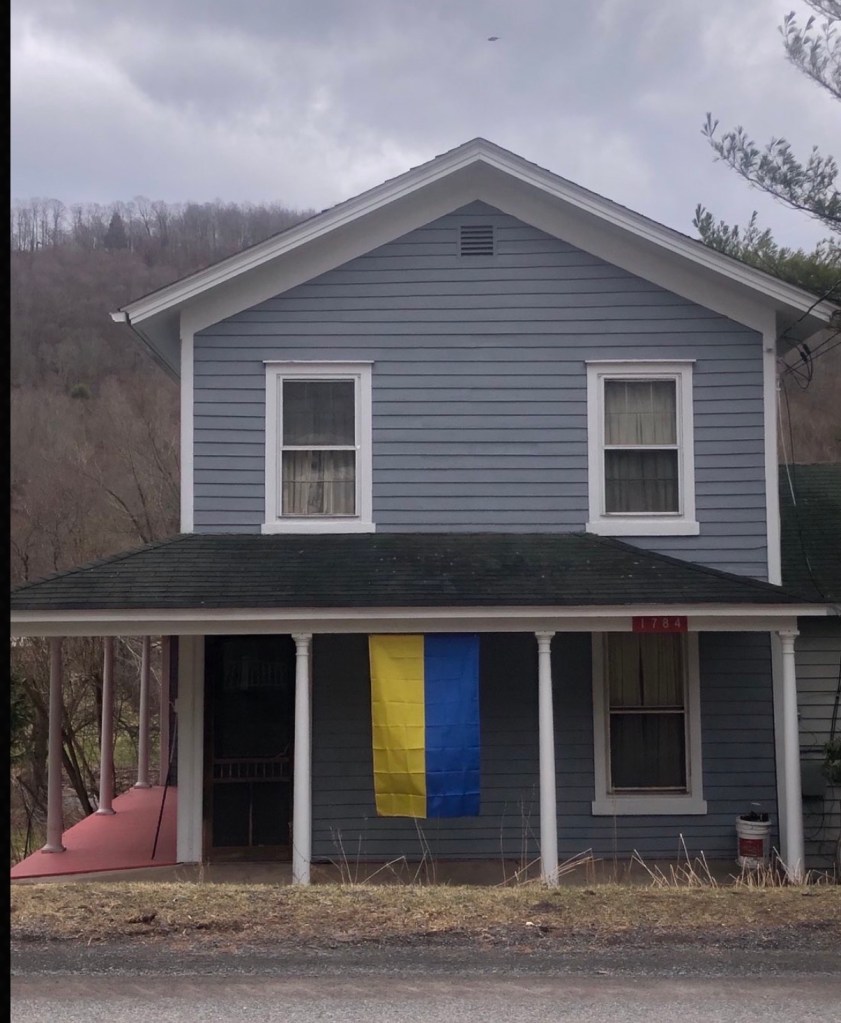
I realize that each of us is resisting in the best way we know how, whether by giving money to progressive causes and candidates, writing editorials, by showing up at protests, or by hanging Ukrainian flags from our homes, as my husband and I have done. Though I admit I’m a bit afraid to hang a Palestinian flag right now, as much as I’d like to.  

I also admit that fear is not to be belittled as a reason for caution.  Two of my nieces in Massachusetts have been affected—one by Doge the other by ICE. Of course, upstate NY isn’t exempt. Recently, there was an ICE raid in a neighboring town. The agents went to a home that had both a Trump banner and an Italian American flag hanging on its porch, which ICE hilariously mistook for a Mexican flag. So there is no limit to the idiocy and evil at work in our neighborhoods even if it isn’t always in plain sight. (P.S. The home owner is still a Trump supporter; she just blamed the agents.)

As I write this, I am less interested in our individual actions than the possibility for a larger collective presence. In the words, of Ras Baraka, the Mayor of Newark arrested for trying to inspect an ICE detention center:  “We’ve seen a bunch of disparate, spur-of-the-moment acts by individuals and smaller groups, but there’s no collective offensive strategy.”

Designers and artists need to do more than parody Trump and his minions, as much fun as that is.  (I imagine the People’s Graphic Design Archive as the site for all the brilliant bottom-up protest signs, especially the Abducted by ICE posters coming out of LA.)  Still, the advice that Ras Baraka and others have given to Democrats holds for designers as well. Namely, there has to be an alternative vision. Vision may be only one dimension of design, but it’s one that still has potential.  (Shepard Fairey comes to mind.)  We could also use some leadership from strategic designers. Decades ago, Ralph Caplan wrote about the sit-in as a form of design. Could that be expanded upon to widen non-violent resistance?

This short litany of visual, aural, and spatial practices isn’t offered to fracture our responses yet again, but rather to suggest realms from which a strong signal might emerge. Whatever emerges needs to be compelling enough to galvanize the public imagination—be it in protest (e.g., the raised fist) and/or in hope (e.g. the rainbow flag). It needs to bring together the resistance bubbling up from town meetings, from the streets, from campuses, and from the less visible grumblings at the proverbial kitchen table. 

These many streams of resistance need brought together to make our interdependence palpable. We can’t wait for messiahs to lead us out of this mess. We need to pave the way for their coming. 

*To be fair, Paola Antonelli’s “Design Emergency” podcasts with Alice Rawthorne do deal with social and environmental issues, though I haven’t seen any related to the US political crisis.

Prophet Song, our 1984

Recently, Paul Lynch’s Prophet Song was highly, not to say forcefully, recommended to me both as an extraordinary work of fiction in its own right and as the 21st century’s successor to George Orwell’s 1984. My first reaction was that its premise—a mother’s dilemmas in an authoritarian state—was too obviously grabbed from the headlines. Yes, if you count all the headlines of the last decade—think just of Syria, Gaza, and Yemen. (The book was published in 2023 and won the Booker Prize that year.) But, no, once you recognize that none of what its protagonist Eilish Stack experiences has ever been the stuff of headlines.

Paul Lynch’s dystopia is personal, not social.  Unlike George Orwell’s 1984, which shows the mechanisms of mind control, Lynch’s Prophet Song immerses us in the subjective terror of living in a state of exception invoked by a government’s imposition of “Emergency Powers.” Instead of situating the crisis within a fictitious super-state as Orwell does, Lynch rejects allegory for the recognizable streets and houses of Dublin, where Eilish lives with her four children and her husband, Larry, the story’s fulcrum.Larry, arrested for leading a teachers’ union protest, effectively disappears. His extra-legal banishment gives Eilish both reason to stay—he might walk in the door any day and what if they weren’t there—and reason to leave, as she slowly realizes that his absence is part of a more pervasive and threatening pattern which will subsume what’s left of her life. First, there are inconveniences: the water in their faucets turns brown, but then there are the intrusions into her psyche. Eilish becomes invisible when her butcher ignores her while serving other customers. A wedding becomes an occasion for party fealty, effectively excommunicating her from her larger family of aunts and cousins. However, it would be missing the point to read the book as a litany of slights and insults.

Prophet Song is less a portrait of the workings of tyranny than it is a portrait of what being tyrannized feels like, smells like, looks like, sounds like, even tastes like. Looking for a paint scraper to remove the graffiti that has vandalized her house, Eilish “meets instead her humiliation as though it were on the shelf before her, the shame and pain and grief moving freely through her body.” Even more recognizable is the confusion of how to think and act under such conditions. Eilish drifts between feeling she has agency—that hope and survival remain possible—and feeling disoriented and powerless. Desperate for signs of continuity with the world as she knew it, Eilish observes that “trees keep counting the time by ringing the time in their wood.” And later, that there is “memory in the weather.” These things cannot be defeated. The disjuncture between the events that threaten to overwhelm her and the constancy of nature is not entirely unfamiliar, albeit in less fraught circumstances. It’s like having a bad flu and looking out the window at people going about their business on a sunny day, and being vaguely (and absurdly) astonished that life is moving on without you.

Eilish’s circumstances are beyond fraught.  She is subject to relentless intrusions without defenses, only children who need defending. A professional woman, a scientist, she is not prone to paranoia and keeps a strong maternal front. She continues to send the children to school, stubbornly maintaining the importance of soon-to-be-obsolete rites of passage like playing hockey and getting into university. When her daughter Molly accuses her of doing nothing to get Larry back, Eilish says, “Sometimes not doing something is the best way to get what you want.” Yet, she does wear the white scarf that marks her as a dissident—and gets her fired. In her vacillations, Lynch captures that uncanny state of being simultaneously aware and in disbelief when reality is no longer solid.

So, while Orwell has enjoyed a justly deserved revival since the first Trump presidency, Lynch’s is the book for this moment. Lynch’s story operates with an immediacy that would have been foreign to readers in 1949, when Orwell’s book was published. They would have recognized the allusions to Stalin’s regime and its bureaucracy of cruelty but they would have the distance of observers, of readers. Set thirty-five years in the future, 1984 would have been read as ‘not yet, perhaps never.’ That luxury is stripped away in the claustrophobic pages of Prophet Song. Its events happen in real time and from innocuous beginnings—a party wins an election. Lynch’s prose doesn’t leave any space to catch your breath. There are almost no paragraph breaks and sentences grow like panic, as when Eilish runs into Rory, an old acquaintance.

He is quick to speak about old times and she watches his face hurrying him along with her eyes, a bus pulls away expelling hot diesel smoke and Rory steps back, his scarf stirring to reveal the party pin on the lapel of his jacket. She takes a step backwards, swallows and closes her eyes, Rory smiling with his teeth.

This is an early hint of ostracization that will ultimately turn violent.  When vigilantes replace neighborly scorn with lethal force, Eilish’s oldest son joins the rebel forces. (He won’t be seen again.) Soon after, her twelve-year-old son is abducted from his school. After an agonizing search, she finds him in a state morgue bearing unmistakable marks of torture and murder. Utterly devastated, she has no time to mourn, to take a breath. She’s still caring for her father, daughter, and toddler amidst accelerating assaults.  Both the rebels and state soldiers seem intent on the destruction of the once peaceable Republic of Ireland—an old story in and of itself.

Lynch’s point in choosing an identifiable place, which today we think of as hospitable, tranquil, and democratic—even cheerful—is to make real the truth that a domestic Armageddon can happen anywhere and at any time.  As Lynch remarked in a PBS Interview, “the civilized world is a thin veneer, so fragile and easily lost.”  He claims, however, not to be writing a polemic of grievance—as tempting as it is to think he’s holding up a mirror to any number of authoritarian governments. Instead, he calls Prophet Song a story of grief. It is both an ancient and a cautionary tale of people divided between those whose lives are entirely normal, and those whose lives are wholly abnormal.

A novel called Prophet Song can’t be anything but a warning of what might come, what will come if power is left unchecked. It just happens to be coming here and now in the United States, where firings and deportations are becoming routine. Terror isn’t an abstraction when you’re tensed for the next assault, when it infiltrates the lives of your family and your colleagues.  Just ask around, it’s hard to find someone unaffected, if only indirectly. In fact, it is the indirect affect that is most powerful, leading to paranoia, self-censorship, and a low-grade fever of fear. It’s viral.

Dissatisfactions

Preamble:  Every year, for the past 27 years, a group of 20 to 30+ designers and educators has assembled at HighGround, first in Buena Vista, Colorado, and now in Santa Fe, New Mexico. Initiated and organized for its first quarter century by designers Katherine and Michael McCoy, HighGround is an informal gathering where each participant is charged with offering a brief ‘rant’ about what they find relevant, perplexing, wrong, and right with design. This year my ‘rant’ was more of a ramble.

2024 High Ground participants

I love this quote from the writer Alfred Kazin: “I am dissatisfied, profoundly so, with the world as it is. But I would be dissatisfied with any world.  And I’d hate to lose my dissatisfaction.” (It’s not unlike the prompt an Italian colleague used as the modus operandi for a course. He called it Complain Design.) That said, I also know that this same dissatisfaction predisposes me against any form of critique that smacks of sentiment, even when it’s well-intentioned.

But I found I had to suspend that instinct after coming across an essay by the textile artist Catherine Murphy. In it, she shared a story about Sarah Corbett, a British activist who coined the term ‘gentle protest’ and established The Craftivist Collective in 2009. Apparently, Sarah had written several emails to her local M.P. that were ignored.  In fact, she was asked to stop contacting the office. So she changed her tactics. Despite their rudeness, Sarah decided to respond in a way that was non-confrontational. 

Catherine writes that she “embroidered a message on a handkerchief that said: ‘I know being an MP is a tough job but please use your power and influence for good. She signed off with lots of smiley faces and ‘yours in hope from Sarah’.” We’re further told “that the M.P. (who kept the handkerchief on a pin board in her office) did, in fact, change her relationship with her constituent.” Yes, Sarah’s message was a bit mawkish, but the medium made it undeniably present. At any rate, I was moved enough (and desperate enough) that I tried to imagine doing something like that here. But my imagination failed.

In our political climate, I’d probably model myself on Madame Defarge—she of Dickens’ Tale of Two Cities. If you recall, Madame Defarge sat next to the guillotine every day, quote “knitting, knitting, counting dropping heads.” Lord knows the misanthrope in me would love to see a few heads drop, but we don’t need any martyrs for the cult.  In any case, Defarge’s ‘craftivism’ was nothing like the virtuous British model. She was engaged in a malignant kind of political action: Her stitches encoded the names of people to be killed.

Now Defarge is usually seen as a one-dimensional embodiment of the Reign of Terror. Though some scholars say Defarge was exacting a righteous revenge for the rape of her pregnant sister by aristocratic brothers. Others claim that Defarge’s story is evidence that sexual violence against women helped fuel the French Revolution. This last assertion effectively—and erroneously—positions Defarge (and Dickens) as a feminist craftivists, avant la lettre.

I have to say, this transposition of present anxieties on the past wrankles. But I’m going to use my ‘dissatisfaction’ to pivot to a different direction, moving from the microcosm of stitching to the macrocosm of history. Case in point, when I was teaching, if you’d asked me about the Enlightenment, I probably would have said that it was the root cause of Eurocentricism, of colonialism, and concomitant white privilege. After all, what else would account for the ravages done to people and the planet in the name of reason and progress?

But I recently came across a book that takes a different view of the Enlightenment.  I’m not crazy about its title – “Left is not Woke” – given how “woke’ has been abused, but its arguments are compelling. Its author, the philosopher Susan Neiman, isn’t making the case that we should go back to sleep. Instead, she takes issue with a ‘woke’ approach to social justice because, in her view, wokeness doesn’t work on the principle of a shared humanity. Not that there isn’t comfort in being among one’s own when confronting a history of pain.  There is.  

The problem is that our identitarian politics run the risk of self-colonizing. They sacrifice the aspiration for a greater politics—one fostered by the self-same Enlightenment, which espoused a universalist view of humanity. Now, Neiman readily admits, and I paraphrase her here, that universalism is under fire on the left because it’s conflated with fake universalism: the attempt to impose certain cultures on others in the name of an abstract humanity. One that turns out to reflect a dominant culture, like corporate globalism, which holds that the key to human happiness is a universal mall.

It is this kind of corruption that misjudges Enlightenment thought as exclusionary, when instead, its chief contribution was a secular concept of human rights. As Neiman points out, those who dismiss Enlightenment thinkers gloss over their writings. Diderot believed that it was impossible to make judgments about China without being immersed in its language and literature and traveling through its provinces. Rousseau argued that compassion comes before reason, and that it’s not just found in humans but in animals too. He also said that Europeans were more interested in filling their purses than understanding the inhabitants of Africa and the East Indies. Similarly, Kant attacked colonialism, protesting the way “civilized intruders” saw the Americas as “lands without owners.”

Did they miss things? Yes. The philosophes didn’t address the rights of women, of children, and differently-abled people, and few, apart from Locke, addressed slavery and none did anything about it. That work was (and is) left to future generations. And as much as the idea of progress has been debunked of late, those rights have been taken up in the ensuing centuries. Though it’s certainly true that the gains won can seem so illusive that it’s hard to have hope at all.

This mindset is having an effect on design, where hope is a prerequisite for practice.  I’ve seen students retreat to identity silos, and demand that their faculty do the same. I’ve worked with young designers who are justifiably fearful of becoming ‘part of the problem.’ But it can go too far. One woman told me she couldn’t contribute to a community project about because it would be too arrogant. We tried to persuade her that she could contribute a perspective that might complement, and, potentially, expand said-project. But she wasn’t persuaded.

The risk here is that this kind of self-effacement on the part of designers will lead to nihilism. It suggests that curiosity about others is merely voyeurism, or worse, the first step toward oppression, when, in fact, change is fueled by curiosity. Our hesitations need to be modulated by conscientious efforts to find spaces of mutuality—while still retaining the differences that make the world interesting. It was Salman Rushdie who said that “Melange, hotchpotch, a little bit of this and a bit of that is how newness enters the world.” We need to find those resonances between ‘this’ and ‘that’ and not let them define us.

To close, I want to circle back to the work of my friend Catherine Murphy—she of the small gestures. Catherine also stitched a piece of cloth, which she posted on her substack.  It read “The altar of Liberty totters when it is cemented only with blood.” This was said in 1786 by Daniel O’Connell, an Irish orator, who campaigned tirelessly for a free united Ireland. But he was also a product of the Enlightenment, and as such, he advocated for “a complete severance of the Church from the State.” No self-serving papist, he. Furthermore, O’Connell was an ardent abolitionist. Frederick Douglass said that his voice was “enough to calm the most violent passion, even though it were already manifesting itself in a mob.”

Douglass is essentially praising O’Connell’s universalist ethos, one that made it possible for him to serve in the British Parliament and without compromising the cause of Irish independence.   Do we think of the two men as ‘allies’—in the parlance of today?  Or do we think of them as united in the cause of freedom? Neiman would say alliances are temporary and would advocate for a bond that transcends the particularities of their causes. I do too. 

Coda: I have since read Samuel Clowes Huneke’s review of Neiman’s book in the LA Times Book Review. He aptly points out that the gap between the espoused views of Enlightenment thinkers and the realities that they tolerated and engendered casts shade on her thesis. While Clowes Huneke skillfully takes Neiman to task, he still confirms my thinking that the problem with the Enlightenment is its legacy, not its aspirations.

Sources:

Susan Neiman, Left is Not Woke, Polity, 2023.

Catherine Murphy, https://thesewciallifeof.substack.com/

The Perks of Post-Socialist Care

I should begin by saying that I like hospitals. I have fantasized about being hospitalized, preferably for at least a week. No one can ask you to do anything, food just shows up, and you get to spend a lot of time in bed. My idea of a guilt free vacation. Plus I’ve always prided myself on having a high pain threshold. But on a recent trip I was proved wrong. I’d travelled to Warsaw to speak at its Academy of Fine Arts and at the School of Form. Both of which are blameless for what happened to break my illusions of stoicism.

When you have the status of professor emerita, i.e., not quite fully in the game, it is gratifying to receive invitations to lecture and participate in conferences. It’s especially the case when the invitations come from Poland where I’ve been involved with various academic initiatives since 2013. Despite intervals of years, professional relationships with colleagues in Wroclaw, Poznan, and Warsaw have developed into lasting friendships.

So it wasn’t a complete surprise when Magda Kochanowska, Head of Design at the Academy of Fine Arts in Warsaw, asked me to not only speak at the third FAIR Design Conference but to also serve on the conference’s advisory committee. No matter that the last time we’d seen each other was in 2015 at the first conference she convened. (This time the theme was emotions. I chose laughter, and it would turn out that a sense of humor would come in handy.)

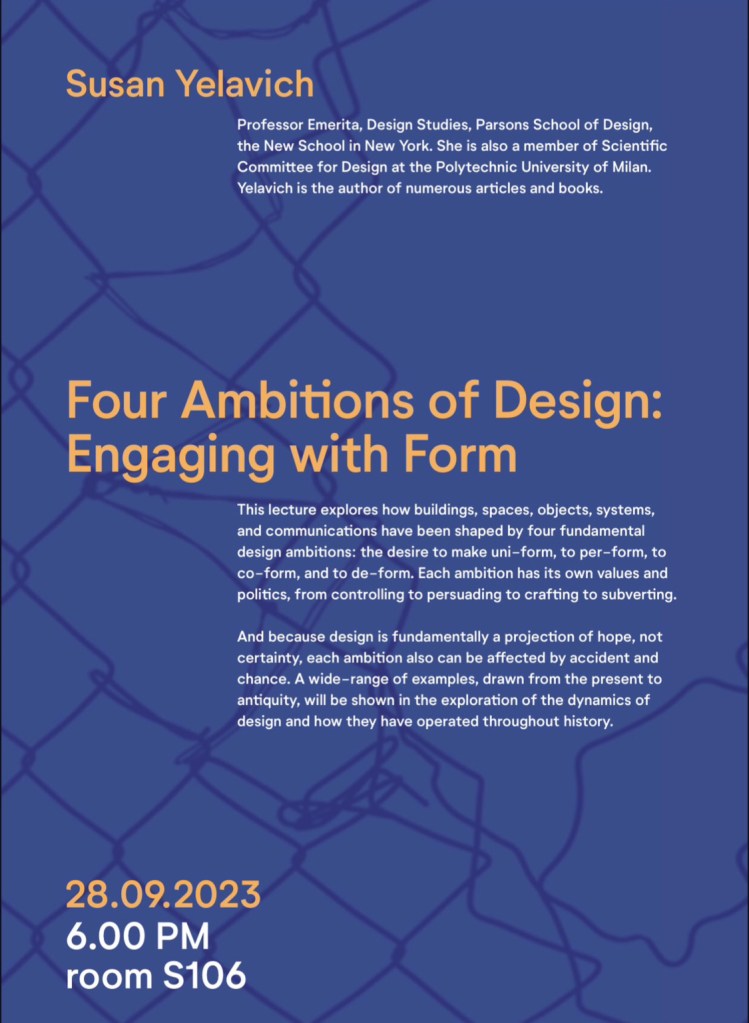
Knowing I’d be in Warsaw for at least a few days, I also contacted Jola Starzak, the Coordinator of the Design Program at the School of Form. Jola and I had taught together twice already in Warsaw in 2017 and 2018. This time she invited me to talk to her students about what I view as four basic ambitions of design—four things design hopes to do, each with its own set of values, each with its own historical trajectory.

So far so good. It would be a short trip—only four days—but they would be very productive. (Little did I know then that four days would become fourteen.)  The lectures for Jola and Magda went well and I was really looking forward sitting back and enjoying the second day of the FAIR Design program. But it was not to be. On the way to breakfast in the hotel dining room, my shoe got caught on the edge of a stair and didn’t release.  I apparently did a kind of strangled pirouette. With nothing to break my fall, I landed hard on my right hip. That’s when I discovered that bone pain is a whole other order of agony.  

It’s also when I got lucky. Several of the hotel staff were trying to pick me up and ask me how I felt—in Polish, of course, which regretfully I don’t speak—when an English woman approached me and explained she was a nurse. Seeing that something was really wrong, she persuaded the hotel to call an ambulance and, much to my relief, explain to the medical emergency staff that I had to be put on a stretcher not in the wheelchair they were offering.  

Unfortunately, I never did catch her name. But she was the first guardian angel of many who seemed to miraculously appear when I needed them. The second I did know: Ula Bzowska. Ula, the student assigned to make sure I didn’t get lost on the way to the conference, turned up at the hotel in time to ride with me to the hospital.  I doubt she thought her hospitality duties would include listening to an American professor yelp and groan for the hours it took to get admitted to University Clinical Center of the Medical University of Warsaw, a.k.a., the Hospital of the Baby Jesus. (More on that later.)  In any case, the pain medication they gave me was having no effect.  Fluent in English, Ula was also my interpreter when I begged for morphine. (No dice.) She told me what the doctors were doing and told the doctors why I was there alone without family. The latter circumstance, as I would learn, was fairly unusual and not without consequence.

Before and after surgery.

left: fractured

right: replaced

After they x-rayed me, I was told that the fracture was complicated (among other things I’d broken the neck and the trochanter) and that to fix it a large pin would be put into my femur. When I woke up from surgery a full two days later—don’t have an accident on the weekend—a doctor told me that they decided against the pin. Like Humpty Dumpty, there were too many pieces to put back together again. But unlike Dumpty, I was made whole again with an artificial hip, cemented into place. 

The next move involved transporting me from a subterranean recovery room to an eight-bed ward, where I was surrounded by other women who’d had more conventional hip and knee replacements. (Mine was a response to a trauma.) In the States, sharing a room with seven other fellow sufferers is rarely a welcome prospect. In Warsaw, I learned its advantages. It was like being in a support group with members who relied on smiles and gestures when words proved futile with me. They were apparently concerned that no family came to visit.

I may have been without family (my husband was at home installing grab bars) but I discovered that there were unexpected compensations to be had in being hospitalized in a post-socialist country. Even if I hadn’t studied the social dynamics of countries that were formally under Soviet dominion (like Poland), I am sure I’d have noticed that there was an entirely different culture operating in and around the ward I found myself in.  

I sensed a lingering tendency to prize the group over the individual in the life of the ward—though not in patients’ respective medical treatments. For example, privacy was not especially valued.  No modesty curtains separated beds. If they had, they would have inhibited the cross-bed conversations that went on into the evenings. I was happy there were no televisions (all tuned to different channels) but that didn’t mean that silence was especially important. Even if there had been a protocol of quiet, the hospital building itself would have made it moot. Built over a century ago, there was nothing to buffer the sounds of clanging doors or the choruses of conversation being conducted in the halls at night. Even the odd sleeping pill was no match for the hospital’s acoustic rhythms.

In general, amenities were scarce. Families are meant to take up the slack and provide things like bottled water, toilet paper, crutches, and pajamas, instead of hospital gowns which aren’t worn once you’re out of surgery. (I’ve since learned that this is not all that unusual in hospitals in southern Europe.) Fortunately, my suitcase had made its way from the hotel to the hospital, so pajamas weren’t an issue. However, the nurses did have to make an exception for toilet paper, as I hadn’t packed any in my luggage. And luckily, departing patients bequeathed their unopened bottles of water to newcomers. 

Over the course of my two-week stay (unimaginable in the U.S.), a surrogate family of colleagues and friends brought me both necessities and morale-building comforts. Jola brought juices and boxes of Ricola lozenges to keep me hydrated. Her visits also gave us a chance to talk further about her work as an architect and the possibilities of turning my lecture on design ambitions into a publication. 

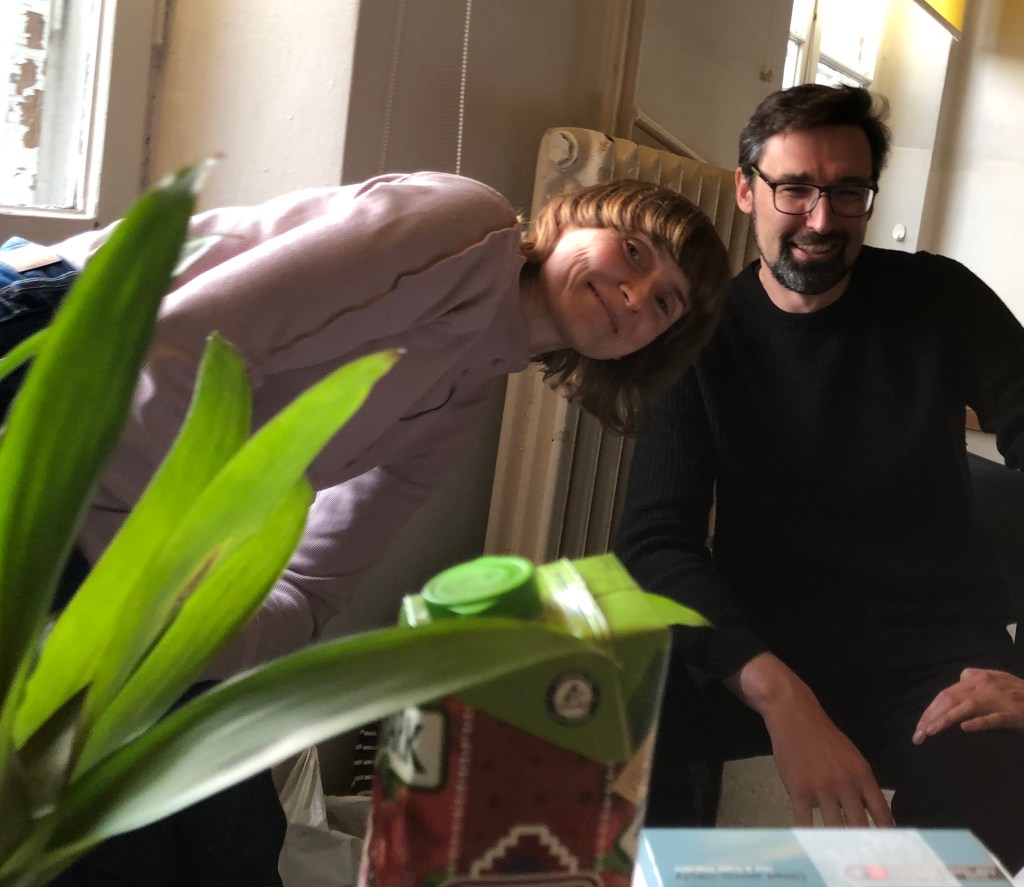
By sheer coincidence, my friend Pawel Pokutycki happened to be in Warsaw for a different conference. He visited several times, bringing a toothbrush from his hotel when mine disappeared, supplying me with health bars, and even a potted plant. Most critically, he replaced my iPhone cable with a longer one so I wouldn’t have to text holding the phone over my head. (The power adapter was plugged into a lamp fixture that was out of reach, making the task of recharging a major headache.) But mostly we had fun talking about each other’s design preoccupations.  

I was touched that Józef Mrozek brought me books and that Grzegorz Niwinski—Magda’s dean at the Academy of Fine Arts—also came to visit. As it happens, his son is a radiologist in the same hospital and he was able to reassure me that not only was I in the best hospital for a hip replacement but also that I had the best surgeon. Another stroke of luck.

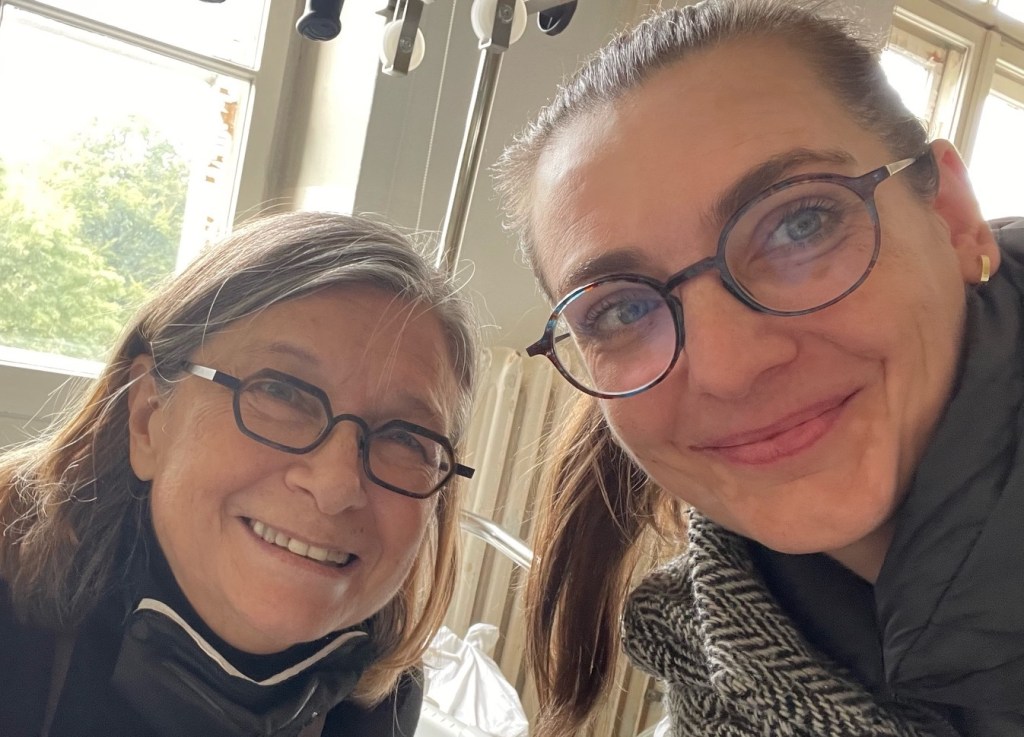
Magda was my most constant visitor. She went out and bought the crutches that the physical therapists insisted I use; she also filled my prescriptions and made sure I had my quotient of sweets, which were definitely not on the hospital diet. There was no jello, pudding, or sherbet on the menu; in fact, there were no menus.  Unlike U.S. hospitals, nothing was even remotely consumer-oriented. This restraint, which I felt throughout Warsaw, could well be a function of the Polish economy, but I imagine it is also partly a hangover from the austerity of communist era, still in living memory for anyone born before the mid-80s. 

Which isn’t to say that this is a culture short on indulgences. Hospitals may keep sugar out of their patients’ diets but not so the city, which boasts numerous bakeries and chocolatiers, like the renowned E. Wedel where I did have a rich cup of hot chocolate before my fall. On my birthday Magda brought me slices of cake from Blikle, perhaps Warsaw’s best-known confectionary. She also brought the best truffles I’ve ever tasted from Cukiernia Sowa. (That Cukiernia Sowa exists at all is a testament to the Polish love of sweets, as it opened in 1946 when was rare for the government to permit such private business ventures to operate and even rarer to find sugar.) 

I don’t think I felt much pain after that.  But when I did, I found another save: taking screen grabs of translations and showing them to my doctors and nurses—an additional reason to keep my phone fully charged, besides being able to talk to friends and family back home.

It was through one of those phone calls that I learned that a Polish-American friend and her sister were coming to visit. Kasia drove in from Zalescia bearing gifts of extra paracetamol and an ice block. Anna flew in from New Jersey. Anna was coming to visit family, cast her vote in the Polish election that ousted the right wing government, and to give mutual friends a tour of Poland. Luckily for me she was able to add a hospital visit to her already-packed itinerary and bring me something comfortable to wear on the flight home. Not incidentally, she also managed to get me a shower. Otherwise, I’m not sure they’d have let me board.

Two more local heroes deserve a mention before this saga ends at Frédéric Chopin Airport. The first was a young man named Yan who stepped in to translate when I came out of recovery. When I arrived in the ward I was barraged with questions impossible for me to answer. Yan, who was helping a friend being discharged that day, explained he was in some kind of training program at the hospital. His interpreting skills couldn’t have been more welcome, as I was still a bit groggy from anesthesia and only able to say ‘thank you’ and ‘please’ in Polish. Yan, who I quickly learned was a missionary, came back for another visit. In other circumstances I would have directed the conversation away from his vocation, but it seemed only fair to ask him about it in return for his kindness. As a parting gift, he gave me a lenticular vinyl holy card with a shimmering portrait of Jesus, probably hoping I would return to the fold. I still have it somewhere.

The second person of note was a nurse named Elzbieta.  Her English was precise, and when it wasn’t she queried me about grammar and usage. We were equally curious about each other. I learned about her interests in cycling and other outdoor activities and she learned how much I loved cities (and walking not running).  We also compared our reading preferences, which, among other things, led to a curious exchange on the day I left the hospital.  It went something like this:

Elzbieta:  You Americans are direct, no?

Susan:  You could say that.

Elzbieta: Well, then. I know you are Christian but are you Catholic?

Susan (biting her tongue from asking how she ‘knew’): I’m culturally Catholic.

Elzbieta: Well, I’m wondering if you’ve ever read Hans Kung.

Susan: Actually, I have. Years ago.  He is an impressive theologian.  

Susan: Have you read Simone Weil? Weil was profoundly religious, though never baptized. You might find her interesting.

Elzbieta: No, I haven’t. Can you spell her name?

And then it was time to leave.  I still wonder why Elzbieta waited more than two weeks to query my religious literacy and can only conclude it was a parting gift. Perhaps it was another attempt to cajole a stray lamb back, this time taking a more cerebral tack. (She gave me no holy cards, though when I got home I discovered that someone put a broken rosary in my luggage.) In any case, I would have welcomed the chance to talk further. But by then the ambulance had arrived and it was time to go.

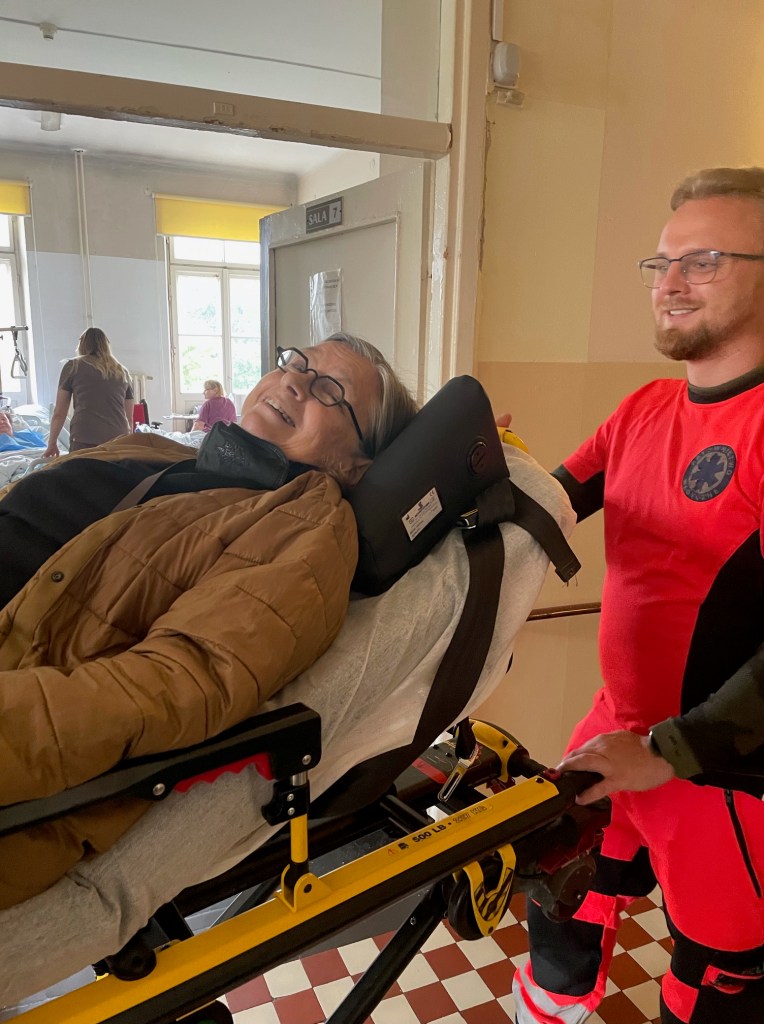
Magda, who had no intentions of letting anything prevent me from getting on a plane (she must have been counting the days), arranged for a medical transport to the airport, a.k.a., an ambulance.  It was a luxury only matched by the business class seat, which I splurged on so I could recline for the nine and a half hour flight. Recline and sleep. Magda made sure I had sleeping pills and painkillers to take the edge off. 

Even a lapsed Catholic like myself might be tempted to concede that the special dispensations of grace (a.k.a., unexpected help) that I encountered during my stay might be attributable to the hospital’s namesake—the infant Jesus, or at least the faith that virtually everyone around me seem to have in him.  What is certain is that I was the beneficiary of the parallel strands of mutual care that run through socialism and Catholicism at their best. And perhaps I was able to recognize them because I grew up in the era of Vatican II’s reforms when the values of the sacred and secular were closer than they are now.  

I know that many non-Catholics, friends and strangers alike, only associate the Church with its faults, and clearly there is no shortage of those, especially among the conservative clergy in Poland. Nonetheless I get impatient with the thinly disguised ridicule that all too often surfaces when the subject of Catholicism comes up. It confuses the Church’s politics with its fundamental ethos of mutual care. 

To be clear, I am not ventriloquizing Yan or Elzbieta, nor making the case for institutional religion of any kind. Nor am I attributing the coincidences of attention and concern that came my way to anything other than innately human generosity. But I do think I owe the optimism I felt during those first two weeks of my recovery to a generalized act of faith that things would get better. And I don’t know if I’d recognize an act of faith without some understanding of the concept of faith. 

Then, again, I do like hospitals.

Both/And: Textiles’ Fluid Dynamics

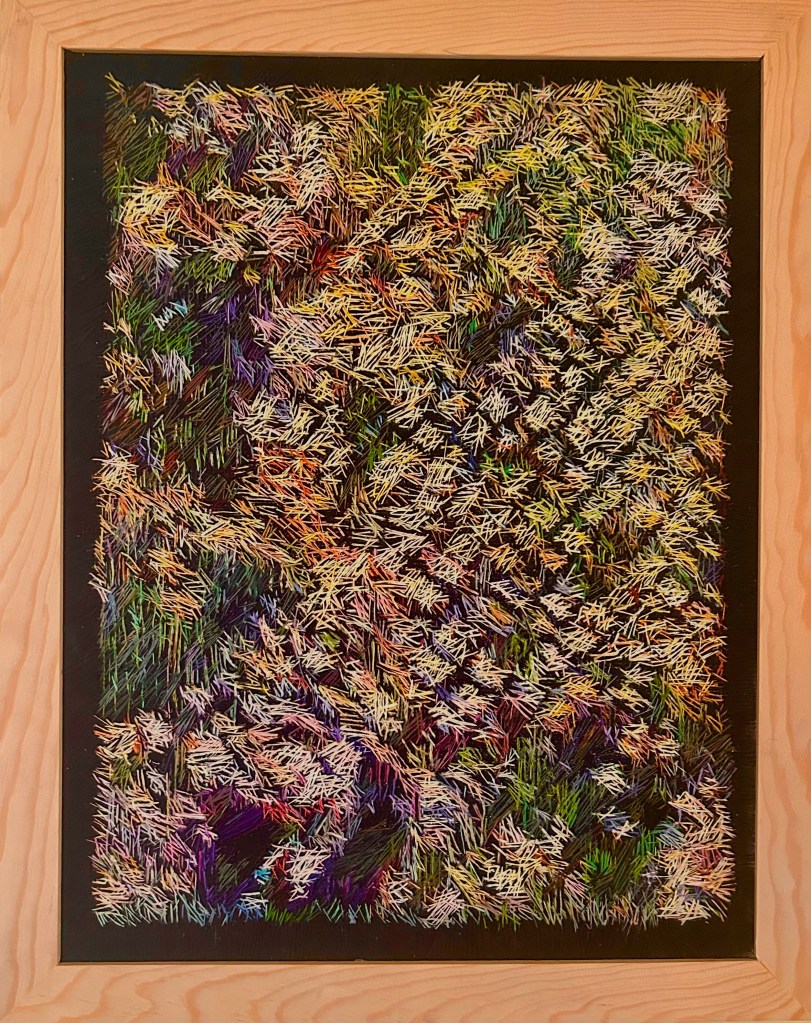
Detail of Stitched Canvas, Yelavich, from “Echo Chambers: David Young and Susan Yelavich, 1053Gallery, Fleischmanns, NY 2022

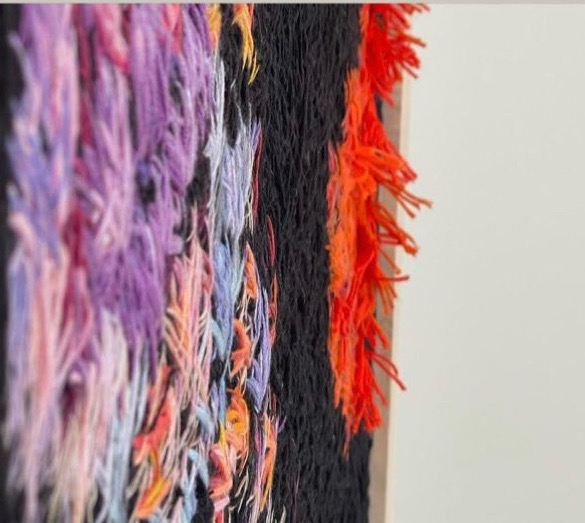
How to account for the attraction of textiles?  For me, it’s their interdimensionality. Both three-dimensional structures and two-dimensional planes, textiles, from the most simply knotted nets to the most technically advanced carbon-fiber weaves, hover between those states. A textile (even one as dense as felt) invites the eye to see its strands and, at the same time, see it as a field. This dynamic becomes further complicated when it is draped, folded, or otherwise attached to some thing or some body. Then thread, fabric, and scaffolding become a trinity of interdependence. 

https://www.sciencedirect.com/sdfe/pdf/download/eid/3-s2.0-B0122270509000466/first-page-pdf

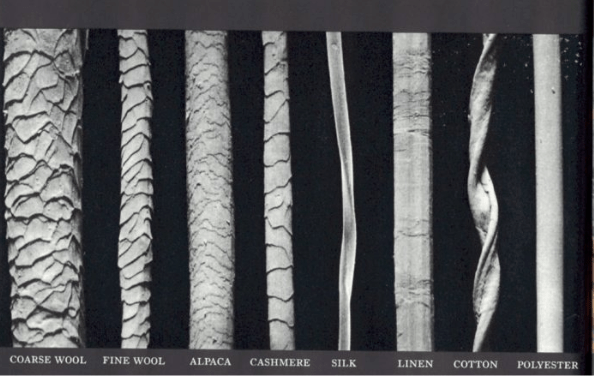
However, the corporality of a textile doesn’t end there. Examined under a microscope, its fibers resemble tree trunks and layers of bark. The resemblance can’t be a coincidence, as trees and plants are also fibrous1 as, of course, are we. Fibers are intrinsic to our bodies; they are embedded in our nervous systems and muscles.2  Though when it comes to bodily fibers, we more likely to think of hair since it’s visible and ready to hand. It can be shorn like animals’ fur, or for that matter, harvested like plants. Birds are especially adept at weaving both plant matter and whatever natural and unnatural fibers to build their nests. Insects like silkworms can produce fibers of astonishing strength to build their cocoons, which in turn are used to make silk. What’s especially interesting about silkworms is their dependence on trees—mulberry trees whose fibrous leaves are the source of their nourishment. So it would seem that the inter-relatedness of fibers—whether of individual strands we can trace with our eyes or in the less apparent fibrous systems that operate in and between animals and plants—is the definitive quality of the textile. Finished or in-progress, a textile is both form and performance. 

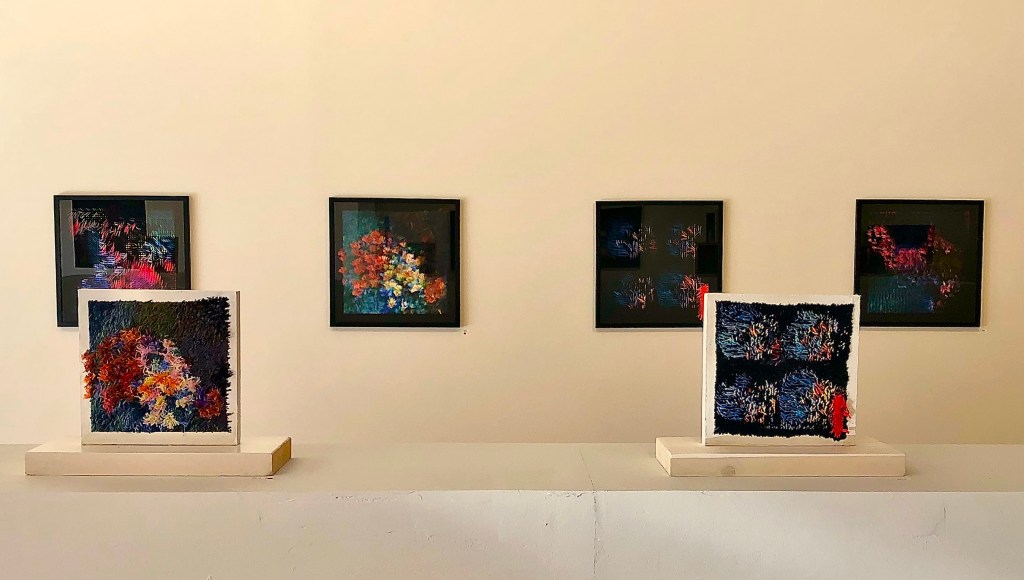
Installation shot from “Echo Chambers: David Young and Susan Yelavich” 1053 Gallery, Fleischmanns, NY, 2022

What of embroidery or stitching which depend on a textile as a foundation? They are qualified textiles that come with adjectives, e.g., embroidered, appliqued, and stitched. This type of hybrid also includes velvets and brocades that integrate one or more supplementary warps or wefts into a basic weave. Unlike these structurally complicated textiles, whose fibers respect a predetermined order, embroidered and stitched textiles don’t necessarily conform to the structure they are grounded on.4 Instead, the threads and filaments offer a counterpoint, sometimes completely obscuring the fabric that supports them. That was the dynamic that operated in the last series of stitched canvases (above) for  “Echo Chambers,” a collaboration with artist David Young and his AI/machine learning programs.

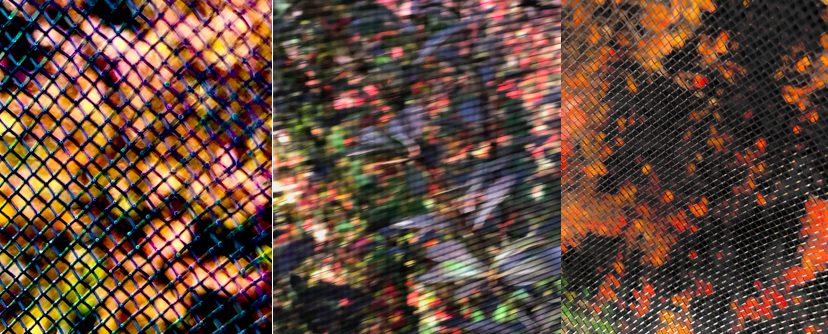
Initial images for “Screens and Screening” (The center image taken by artist Joyce Haut was the catalyst for this series.)

Our next project, tentatively titled, “Screens and Screening” explores equivalences between figure and ground, between surface and structure, using a wire mesh screen as a point of departure.  A series of digital images were shot through three screens—the analog mesh of a screen window (and in some cases a kitchen sieve), the camera’s grid (a Bayer filter5), and the computer screen’s grid of pixels.  

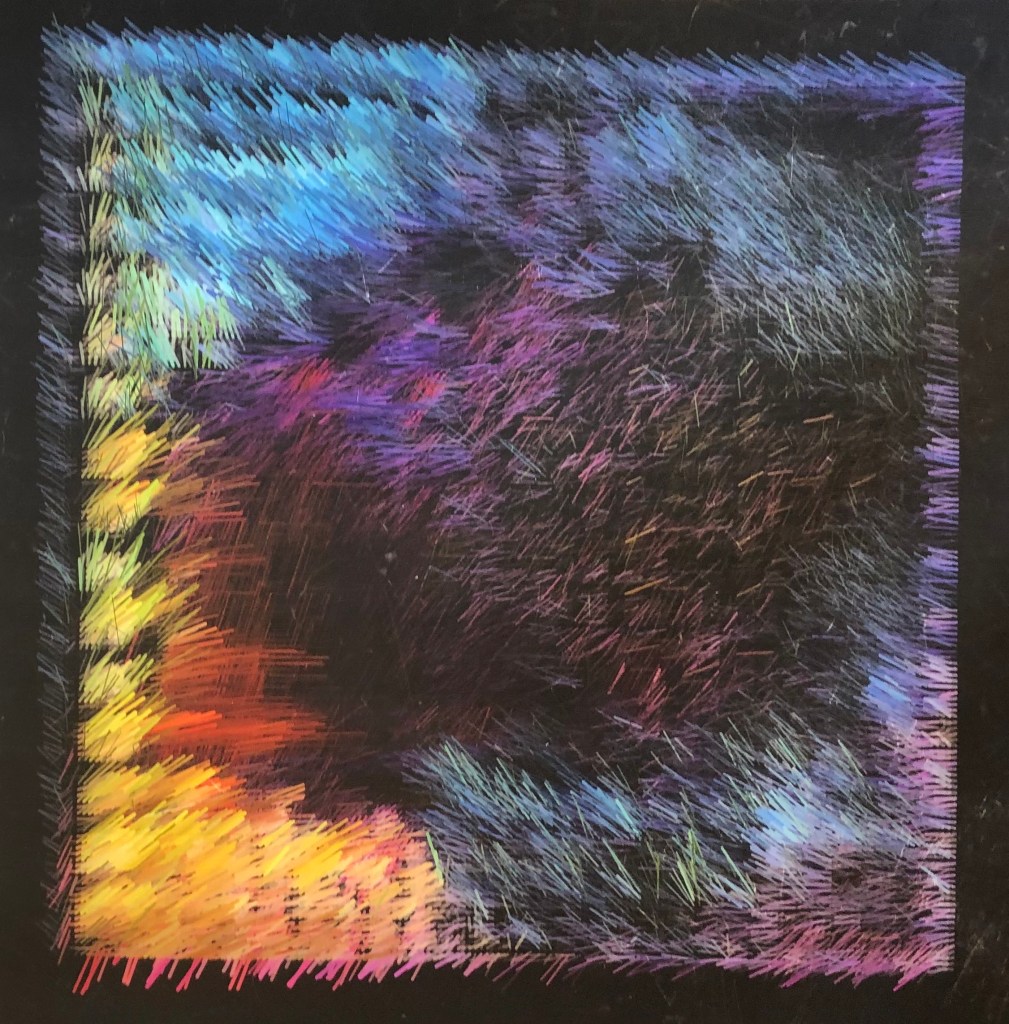
The resulting composite image (below) is then printed on fabric mesh (the fourth grid) for me to stitch back into a jittery analog state, a.k.a., a new textile.  The ambition is to capture an intrinsic quality of all textiles, namely that of being in tension between states of open and closed that mirror the ones and zeroes of the digital.  

First “Screens and Screening” print to be stitched, courtesy David Young and AI/machine learning

A year or so later, here is the final stitched interpretation

Notes

1. Plant fibers are found as structural elements in all higher plants. Botanically the fiber is considered to be an individual cell, which is part of sclerenchyma tissue and is characterized by a thick cell wall and a high length-to-diameter ratio (reaching 1000 and more). The basic function of sclerenchyma is providing mechanical integrity to the plant. Spindle-shaped cells with tapered ends are considered to be a characteristic feature of the fiber cell. According to this definition, cotton (Gossypium spp.) fiber – probably the most well-known plant fiber – is not a fiber, but a trichome, the extrusion of epidermal tissue. CELL WALLS AND FIBERS / Fiber Formation J E G van Dam, WUR, Wageningen, The Netherlands T A Gorshkova, KIBB, RAS, Kazan, Russia Copyright 2003, Elsevier Ltd. All Rights Reserved.

https://www.sciencedirect.com/sdfe/pdf/download/eid/3-s2.0-B0122270509000466/first-page-pdf

2. Kamrani P, Marston G, Jan A. Anatomy, Connective Tissue. [Updated 2022 Jan 24]. In: StatPearls [Internet]. Treasure Island (FL): StatPearls Publishing; 2022 Jan-. Available from: https://www.ncbi.nlm.nih.gov/books/NBK538534/

3. Which isn’t to exclude geotextiles or synthetics; even a nonwoven fabric is bonded together by entangling fibers or filaments.

4. An example of an embroidered textile that does conform to its fabric ground is the stitched sampler. In fact, it was a lesson in order for young women in centuries past—the stitched equivalent of penmanship on lined paper. However, most traditional embroideries were meant to animate a plain fabric, not to submit to its discipline. 

5. The Bayer filter is a thin plastic film inside a digital camera that enables color imagery. It filters light through a grid of blue, green, and red squares.

Stitching light, analog and digital

Detail of stitched interpretation of AI reading of a darn

Lately I’ve been turning my attention to both the phenomena and the artifacts of pixels by stitching them. It began a couple of years ago when I made a casual observation to the designer/artist David Young that  some of his digital images bore an uncanny likeness to textiles. David’s images are particularly interesting because he creates them (actually, co-creates them) with artificial intelligence and machine learning programs. Sometimes he trains the AI on color blocks, other times, on landscapes.  We decided to see what would happen if he trained it on an actual textile—specifically, one of my darns, which are small, stitched weaves of thread. The result is an ongoing project we call Echo Chambers. (For the full backstory see: Negotiating the Image with Pixels and Thread.)

Print of the AI’s interpretation of a darn, manipulated by me with David Young’s custom software

In a nutshell, David trained the AI on a dozen or so photos of my darns.1 (This is the opposite of usual practice, which is to train the AI on hundreds or thousands of images so it can replicate whatever it’s been shown).  In any case, this AI builds a neural network of a darn      and the neural network generates images from its understanding via pixels. At some point, David stops the process, selects a still frame, and then we manipulate it with his custom software. The resulting image is printed on paper and transferred to mesh or canvas.  I then stitch it back into existence by referring to the lines on the mesh as general coordinates, but mostly by looking at the printed image.

When I started this project, I was simply curious to see what the translation would yield.  It quickly became a challenge to see how closely I could replicate David’s images. But the more I worked on them—I’ve now made 8—the more I wondered whether I was just doing paint by numbers with embroidery thread, or if the project could open up different ways of understanding the binary nature of stitching (which goes above and below a plane) and the binary of the digital’s ones and zeros.

Still from AI/machine learning view of a darn rendered in pixels

First I had to figure out exactly what it was that I was stitching, namely pixels. Thanks to Hugh Dubberly and Alvy Ray Smith’s book The Biography of a Pixel, I learned that pixels are derived from the crests of spatial waves1—waves mathematically derived from the patterns and intensities of light and dark that fill our visual fields. (The model comes from our biology. The eye’s retina transforms a visual image into a neural code of sine-waves that take their dimensions from the size and contrast of what we see.2)  

As far as I can tell, pretty much the same thing happens when analog is converted to digital. Except that it’s a sensor, not the brain, which translates the waves of contrast and scale into pixels. And for what it’s worth, Alvy Smith is at pains to say pixels aren’t squares.  The information contained in the crests and valleys of the waves is just translated into squares by reconstruction filters, or sensor grids, that collapse those peaks and valleys.3

Smith also tells us that both analog and digital images contain a lot of information that’s unavailable to our eyes because there is an infinity of points between the crests of the waves. Oddly, or maybe reassuringly, analog infinity is larger than digital infinity. 

So digital images are a compression of what we see in the real world. Which means that this Echo Chamber project is about the compression and decompression of my stitching. Compressed data is decompressed by stitching. And that introduces light back into the picture as it were:  Light bouncing off threads, light changing with the time of day, and with the effects of local color.  

But more than that, for me, it is an exercise in bringing the digital image into another state of being that is only partly predictable. It’s like knitting into the void of the space ahead of your needles. You both know and don’t know what will appear. No matter how mundane,what emerges, that something emerges, is always surprising. 

In any event, I’m wondering if the AI’s neural network input (my darning) and its output (the digital still) are yielding pregnant images. Perhaps the stitching is tapping into the infinity of points on both spatial waves and light waves to reveal otherwise invisible patterns—patterns that are still born when they’re printed, still born until I stitch their true subject, which is not a darn but light. 

What I do know is that stitching along and around lines of color (derived from pulses of colored light) printed on mesh, and then seeing them come into three-dimensional stitches is a bit uncanny. The result has the quality of a doppelgänger—albeit off-kilter and inexact. In these “Echo Chamber” pieces, there is a movement that is both seen and sensed, animated by reverberations from the liminal space between subject and object.  A phenomenologist might describe it as suspending conceptualization to reveal experience, which is probably why I still can’t pin down the meaning of the project, except to say that it seems to operate beyond the binary. Logic says it is not, but I cannot explain away the surplus of meaning I sense and see. 

Notes
1. Alvy Ray Smith. The Biography of a Pixel. (Cambridge, Mass.: MIT Press, 2021), 32.

2.  “Quality of vision in refractive and cataract surgery, indirect measurers,” Tais Renata Ribeira Parede, Andre A. M. Torricelli, Adriana Mukai, Marcelo V. Netto Review Arquivos Brasileiros de Oftalmologia · December 2013

https://www.researchgate.net/publication/260131039

3. Smith, Ibid., 51.

Threading the Pixel

What the human eye observes casually and incuriously, the eye of the camera notes with relentless fidelity.”   – Bernice Abbott

Work in-process

Lately I’ve been reading about the nature of light, specifically the light in (or is it of?) pixels. This is part of a larger project I’ve embarked on with David Young. (See Negotiating the Image with Pixels and Thread.) David produces exquisitely elaborated digital images that he co-creates with his custom-designed AI/machine learning programs. To date, our work has been built around his manipulated images of my darning (a form of woven mending), which I’ve been translating back into an analog state by stitching the computer-generated images onto canvas. 

One of my darns

I’m not interested in bringing the darn full circle, i.e., from cloth to printed image to stitched image. Rather than trying to produce a faithful replica, I’m interested in the process as a translation. I’m producing an analog version of what the AI does with the images it is fed.  Both the computer and I produce distortions. I do it with thread and the computer does it with pixels. But is this a child’s game of telephone or a double transubstantiation?

Precisely because I understand so little about the computer’s ‘translation’ of my crosshatched threads, I’ve become especially curious about the nature of pixels I’m stitching. Given that the same digital image can morph from fuzzy to spikey, from dense to sparse, when it’s manipulated on the screen, I wonder if a pixel behaves like a musical note which can be extended, dampened with a pedal, or sharpened by a quick touch.  Is there latent information in pixels that accounts for the variability in their appearance from one shift of a button to the next? 

I’ve tried reading Alvy Ray Smith’s A Biography of the Pixel and am still trying. I’ve also bumbled around on Internet sites. They’re like foreign language phrase books, good for discrete definitions but no help with integrating them into a sensible conversation.

Finally, I called on my friend Hugh Dubberly for help. A design luminary in the digital realm and an excellent (a.k.a., supremely patient) educator, I hit the jackpot when he said yes. I won’t rehearse his lesson (conducted largely over a two and a half hour Zoom), except to share the most relevant nuggets of the processes involved in producing digital color photographs. (Apologies to Hugh, in advance, for the quality of my translation; and apologies to readers who find this tedious.)

  • Natural light (in my case. bouncing off my stitching) enters the camera lens.
  • That analog light is interpreted by sensors.
  • Three sets of sensors are needed for color images to be constructed and seen.
  • Each set has a different color filter (a thin piece of plastic): red, green, or blue.
  • Clusters of these RGB sensors are arranged in a grid. In other words, there are many sets of sensors behind the camera’s lens.
  • Each sensor measures the brightness value of the light it receives and translates it to a digital (a.k.a., numerical) value.
  • That information is stored in the camera/computer.
  • When the user (I hate that term but it will have to suffice) retrieves that image (brings it up on their screen), they have a choice about how to display the stored pixels (a.k.a., stored ratios of filtered light intensity).
  • That choice is exercised by changing (or not) the numerical values measured by the sensor’s filters. 
  • What we see is a translation of numerical data to images made of light on our screens.
  • Screens are made up of display elements.
  • A display element can hold different numbers of pixels.1  
  • Changing the ratios between pixels and the screen’s display elements alters the image. (This is probably ‘coals to Newcastle’ for most readers but it was helpful information for me.) 
  • Each pixel offers up to 256 choices, which together make up the pixel’s bit depth.
  • Together the joint RGB pixel offers 16.7 million or 224 (two to the power of 24) choices of color.2

This last point was the one that answered the question I started with:  ‘Is there latent information in pixels that accounts for the variability in their appearance from one shift of a button to the next?’ What I was calling ‘latent information in pixels’ was, in fact, their dimensionality, their depth. And the clue was that pixel size is calculated by square roots. I remembered enough high school math to recognize that squaring a number—in the case of a pixel: 224—describes a three-dimensional space. (I also remember enough physics to know that light has velocity which entails time, as well as the dimensions of its waves; so light is multi-dimensional.) So my suspicions were correct (if not my reasoning): there is real depth in the image, at least on the screen. When the image is printed, I see it as an illusion but no more of an illusion than any other photograph.

I also recognize that there is an element of absurdity in this labored examination of the pixel. But in order to get a grip on what I’m doing, I find that, to paraphrase Roland Barthes’ observation in Camera Lucida, I have to work in two modes: one of calculations (available to anyone who knows where to look or who to talk to) and one of singularity to replenish such those calculations “with the élan of an emotion which belongs only to myself.”3

This print of a digitalized and manipulated image of a darned textile challenges the eye to discern its discreet elements.

Now I think have some comprehension of the variability possible in a single image that David retrieves from his AI/ML operations. However, it doesn’t lessen my fascination with them. Understanding them as calculations of measurements of light doesn’t denature them in the slightest. For there is another factor at work that I haven’t mentioned: the human eye/brain. Specifically, mine.

It has only recently dawned on me that this on-going project that David and I call “Echo Chambers” mirrors a predilection I’ve had for as long as I can remember. Namely, the near futile effort of trying to tease out specific elements in a densely packed space.

Close up of an Etch A Sketch screen. Lines are made when a stylus behind the screen scrapes away a coating of aluminum dust.

 In fact, I had a dream as a child in which lines would cross over each other against a white background. (N.B., there were no computer screens in 1955, so it was just a blank field.) The dream would turn into a nightmare when the lines got fuzzy and tangled and I couldn’t tell them apart. Then it made me anxious; now it gives me pleasure. Maybe it was a case of early optical migraines (which I still have) or maybe I was seeing floaters. Or, even more likely, it was a dream about my Etch A Sketch toy. (Though the red case, which you can see a glimpse of in the image above. wasn’t in the dream.) In any case, it seems I come this attraction to compressed spaces honestly.

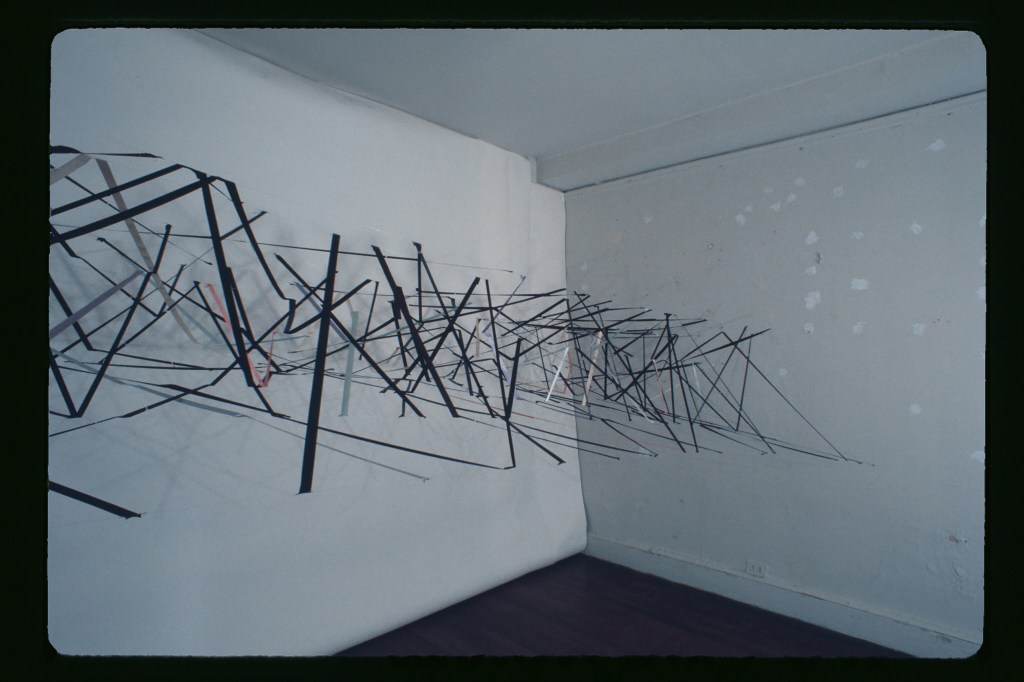
I even went through a spell of constructing those spaces in the late 1970s. I’d just moved to New York City and was struck by the patterns of the fire escapes that cross-hatched so many buildings. It is also telling that I chose to describe that appearance of compression with a textile, specifically lines of ribbon, pinned onto monofilament, which was attached to opposite walls with nails. (Not sure what my landlord made of the scarification of the bedroom that had to double as a studio after we moved out.)

Untitled, ribbon and monofilament, 1977

Decades later, my attempt to derive stitched versions of pixels is yet another attempt to tease multiple layers of lines apart. Only this time I’m using thread to see into the patterns made by lines of light.

Detail of ‘digital darn’

And, of course, thread has its own degrees of luminosity and spatial dimensions. Paint or resin might capture light more effectively (I’m sure it would) but those methods would involve an aqueous process. I find that constructing with colored threads better approximates the way pixels construct an image. I am not shaping the thread into the square units but I am pulling it through a mesh of square openings. The canvas is my display screen; I manipulate the ratio of stitches to the display screen, creating coarser and finer versions of the printed digital image.

Whether this has any meaning beyond the material satisfaction it affords me (and possibly others) is an open question. For the present, I prefer to think of the stitched surface as a very modest exploration of the threaded textile as mediator as well as a medium in itself.   

Current work in-progress

Notes

  1. Typically, one display element maps to one image pixel; however, when images are scaled on screen, then several pixels might be mapped to one display element (for zooming out)or one pixel might be shown by several display elements (for zooming in).
  2. That is, 256 possible Red levels x 256 Green levels x 256 Blue levels is 16.7 million possible combinations.
  3. Roland Barthes. Camera Lucida: Reflections on Photography. Trans. Richard Howard. (New York: Farrar, Strauss & Giroux, 1982) 76.