Close space

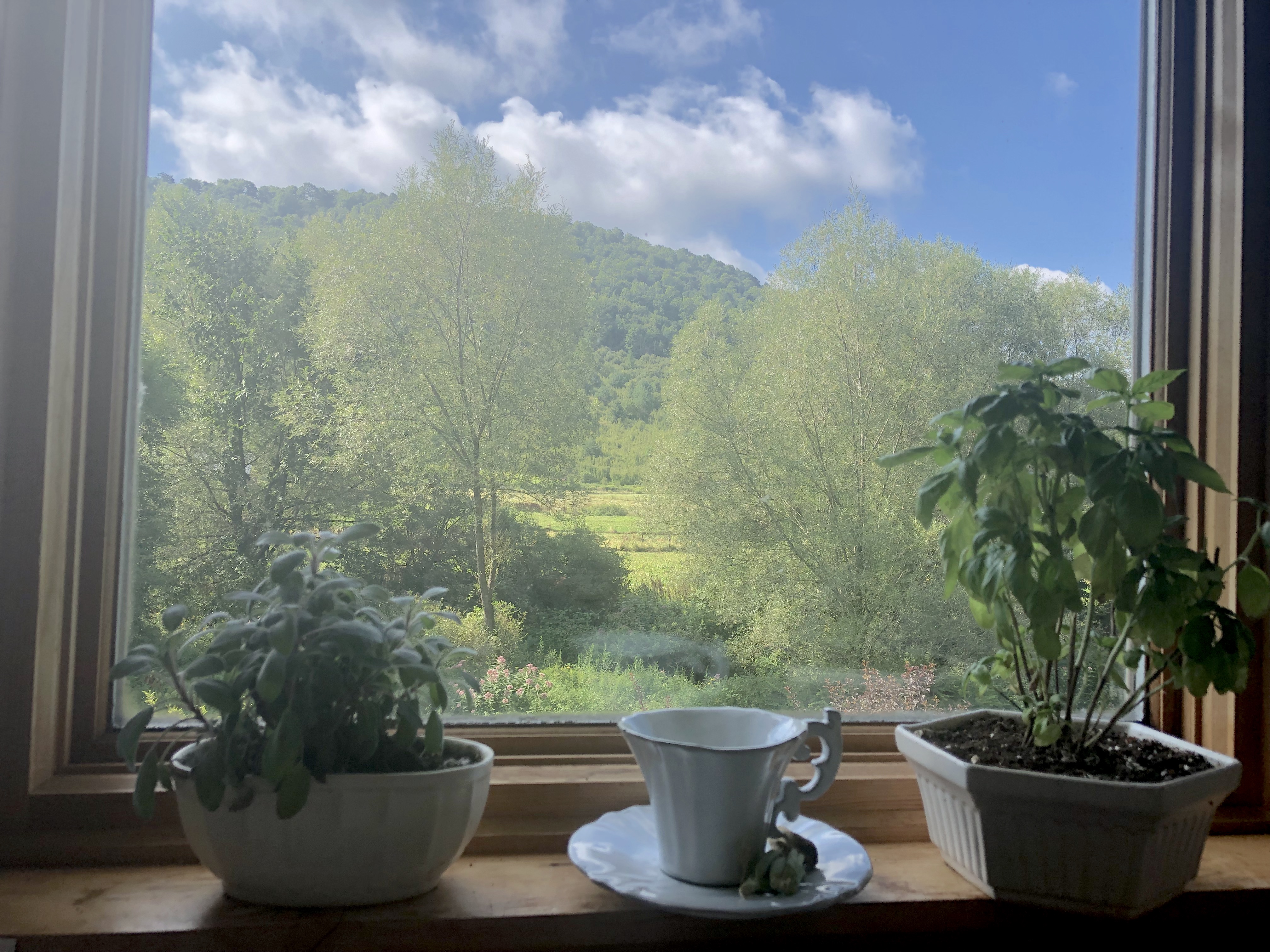
If I were writing a novel about a woman at home in the morning in the country, I’d begin by describing the stillness. The woman would just have to open a door to change that, but she doesn’t because she feels cocooned by the quiet.  She’s reluctant to break the narrow space that is taken up by her plants on the windowsill and the long kitchen table, where her laptop sits on top of a pile of books so she won’t strain her neck. The laptop is this laptop, above it and outside the window is another tight view—this one of the hill that arcs across her field of vision. Not quite flattened, the scene that fills her kitchen windows has a limited depth by virtue of being framed by the window mullions. Sitting in the front row of this green theater are herbs in white pots: one with classical fluting like a pilaster stretched at six points, another molded like brick work, and another with widely spaced lines curving up to the rim and circles around its base.  They too are satisfying in their apparent completeness. These ordinary oddities, coiffed with basil, sage, and thyme, are exercises in control, defeated by the plants themselves as they persist on leaning toward the sun.
Indifferent light

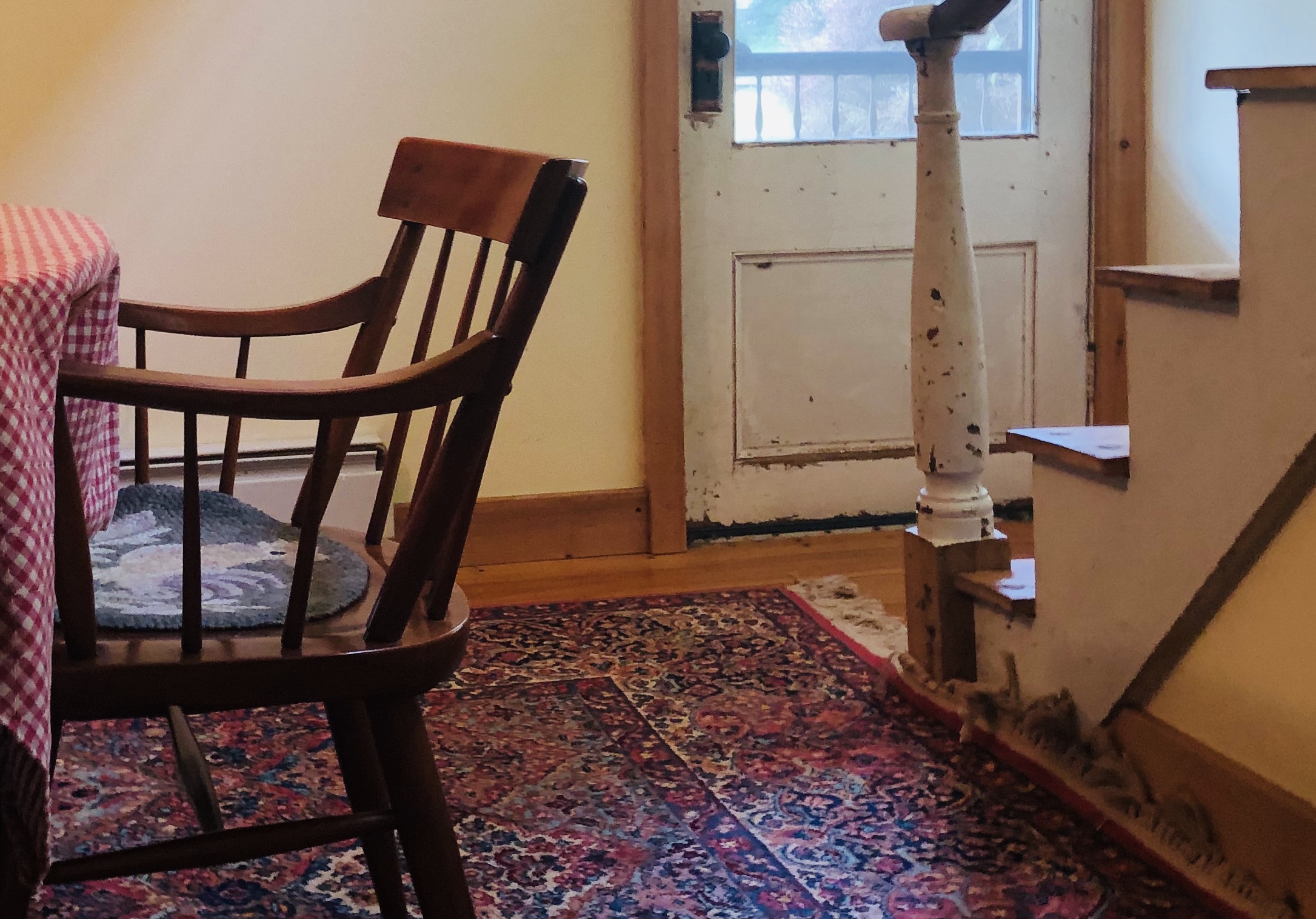
Today, the sun is even brighter and the sky is devoid of clouds. The atmosphere is indifferent to the human pain below it, in it. (After all, the sunlit sky is what we inhale). Such atmospheric imperviousness makes it possible, even easy, for me to drop the thin veil of mourning that conscience wears. (Were it cloudy, could I write this? Unlikely.)  The insistence of the morning light forces my attention away from the flat screen of the weekend’s shootings. Instead, in a fit of domestic voyeurism, I’m watching the one of the spaces in our house, a space whose air is undisrupted except by the passage of light within it. I’m staring at the front room – part dining room, part way-station for things in transit –intruding on a barely-stilled tableau that hovers between two and three-dimensions. The players include my parents’ 1960’s Shaker-style cherry chairs and table, a copper chafing dish, two distinctly Western landscape paintings from my husband’s family, and under it all, my mother’s Karastan rug from Macy’s in New Jersey. Despite the fact that we’re family, the denizens of the dining room are as indifferent to me as death. (Just as the the sky is to the grief in Texas and Ohio.) But this isn’t a matter of unrequited love. I already have the love gifted to me through them. And as for the objects themselves, they may be technically mute but their forms have dialects all their own: overlapping silhouettes, patterns peeking through the chair legs, pictures adding dimensions to the flatness of the walls. Moreover, I have no doubt that something ‘real’ emanates from their molecules and the particles of light that animate them. The oil of fingerprints polished away by Old English, the oil-based colors of painted sky and rocks, the industrial dyes of the rug: they take longer to die.

Acutely distant grief

 I suppose this is always the way it is.  The day is sunny, the birds are noisy, and the stream keeps up a bass line underneath it all, taking no notice of those who grieve. Why should it be different today because of two mass shootings in less than 24 hours, in El Paso and Dayton, where no doubt the sun refutes our reality?  After all the sun is quite far away and is dying too. Superstitiously we all think we’ve been spared and will be spared.  No grieving today for someone we know. Our grief is light-years away from the source of the anguish.  We are hypocrites in the face of daily death. We say we mourn but we don’t. Not really.  The country should have a day of silence. We would have to listen not to each other but to the frequencies emitted by creaking floorboards, refrigerator motors, water in the pipes, the crunch of gravel, the grackle’s squawk, the slap of bare feet, or whatever fills the space we usually pack with platitudes.I suppose this is always the way it is.  The day is sunny, the birds are noisy, and the stream keeps up a bass line underneath it all, taking no notice of those who grieve. Why should it be different today because of two mass shootings in less than 24 hours, in El Paso and Dayton, where no doubt the sun refutes our reality?  After all the sun is quite far away and is dying too. Superstitiously we all think we’ve been spared and will be spared.  No grieving today for someone we know. Our grief is light-years away from the source of the anguish.  We are hypocrites in the face of daily death. We say we mourn but we don’t.  Not really.  The country should have a day of silence. We would have to listen not to each other but to the frequencies emitted by creaking floorboards, refrigerator motors, water in the pipes, the crunch of gravel, the grackle’s squawk, the slap of bare feet, or whatever fills the space we usually pack with platitudes.


The sun is very far away.