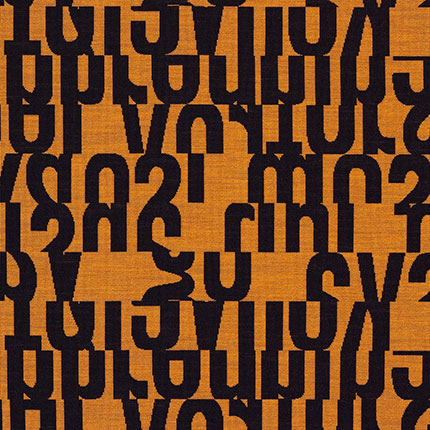
Logomachy- the politics of

Andersen Letters, Gunnar Aargaard Andersen 1955

“Mr. Conte …  has casually dropped words like logomachy.”
New York Times, Aug. 29, 2019


It seems that Italy’s Prime Minister Giuseppe Conte not only cuts una bella figura (we are told he wears purple ties), he is also something of an aureate orator: either golden-tongued or just affected, depending on your understanding of aureate. And if you engage in logomachy. 

Presumably, for most Times readers, these gossipy snipes were a bit of extraneous color commentary wedged into the bigger story: Conte’s brilliant side-lining of Matteo Salvini. It is one of the few political successes in countering one of the all-too-many rabid nationalisms that would happily replace democracy with fascism. 

As encouraging as that news is, the prose that delivered it is disheartening. There is an unmistakably pejorative undertone signaled with a wink and a nod by “purple” and “logomachy.” The former characterizes Conte as a dandy and the latter as pretentious. They have the effect of reinforcing a persistent stereotype of Italians as preoccupied with form at the expense of substance. Not to be taken seriously, at least in politics. 

But it’s the implicit disparagement of “logomachy” that really sticks in my craw. Discovering a new word (and it was for me) is one of life’s small but delectable pleasures – and it’s free. More importantly, logomachy – literally, word-fight – is a popular democratic sport. When the meaning of words is dictated and not debated, there’s a good chance you’re living in a totalitarian state.

Logomachy asks that we “step in between the words.”(1) That we turn them around and see them from different perspectives.(2) Like letterforms, words have bodies and sensory properties. The hard “g” and “ch” give logomachy its combative tone. Happily, that’s muted by the awkward marriage of its parts: “logo” is definitive,  “machy” seems messy. Like democracy. Always an act of faith, no more so in Italy than here at home.

1. Olga Tokarczuk, Flights. (New York: Penguin, 2018) 73.
2. And clearly not the inverted Orwellian logic of nomenclatures like the Democratic People’s Republic of Korea. I’m thinking of words here from a phenomenological perspective.
3. My bifurcation of ‘logo’ and ‘macho’ isn’t a guide to the word’s pronunciation, which is lo-gamachy. Emphasis on ‘lo.’
Letting Persephone go

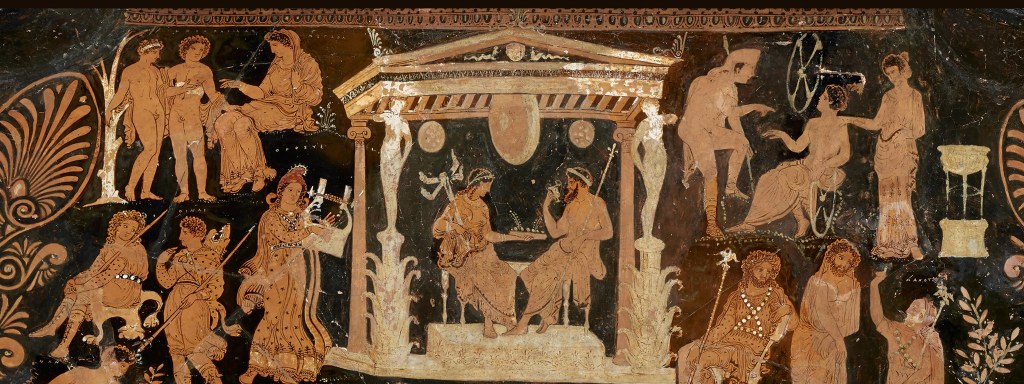
Funerary Vessel with an Underworld Scene (detail, pre-conservation), South Italian, made in Apulia, 360–340 BC; found in Altamura, Italy, in 1847, terracotta. Red-figure volute kraterattributed to the Circle of the Lycurgus Painter

“Can’t fathom where August went.”
“Where did it go?”
“That was quick!”

So goes the small talk as summer wanes. We speak about time as if it’s hiding, which is not so far off the mark. August actually does go somewhere. Like Persephone, the eighth month of the year is abducted only to return the next. If we’re going to be specific, on the 335th day of 2020. 

Futile, but nonetheless felt, the sighs that accompany August’s departure will soon give way full-throated protests at the prospect of the colder months to come. Winter marks our seasonal reunion with Hades. For some, it’s literally and figuratively a hellish prospect. For bears, box turtles, hedgehogs, and their kindred humans, it’s a welcome invitation to hibernate.  

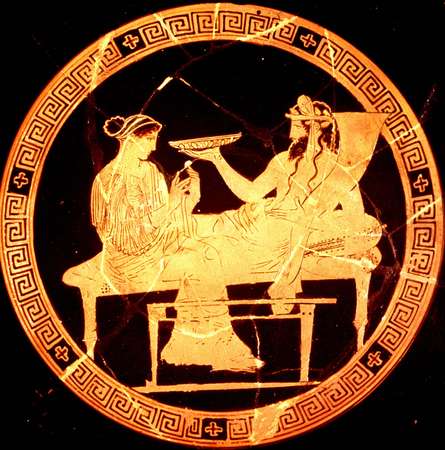
A tondo from a red-figure kylix depicting Persephone and HadesVulci, c. 440-430 BCE.

Counter-intuitively, Persephone’s story makes the case for winter: While Demeter is in the throes of loss at the disappearance of her daughter, said-daughter doesn’t seem to be suffering, at least to go by the Greeks who invented her. As Queen of the demimonde, Persephone doesn’t waste her time grieving or counting the days. She makes the most of her confinement, supping and dining with Hades in full royal regalia. Admittedly, in lighter garb than New York winters demand. Moreover, during her hiatus she’s fattening up before spring – just like the rest of us. 

Cronus and the Omphalos stone, Athenian red-figure pelike c. 5th B.C.

Today, we lesser mortals are told that seasonal rhythms governed Persephone’s existence have become all but obsolete. Historians of modernity are quick to point out that we’ve designed time away. The predictable cycles of agrarian life have long since been supplanted. They were uprooted not just by the shorter production schedules of the now-decrepit industrial revolution, but also by the digital flows that continue to do their best to murder Chronos, who not coincidentally is Persephone’s grandfather.  We seem to have gone from circular time, to linear time, to no time at all.

Perhaps that’s the reason why I look forward to my reunion with Hades. It’s a protest against the negation of time. Winter slows things down, or so I choose to think. Snow brings quiet. That’s a fact. Cold stokes the firing of synapses and more, not less, gets done before the vernal equinox. Or seems to. 

Climate-watchers will (rightly) take issue with such romanticism. They will point out that we have also designed away the weather. What were buildings and clothing for in the first place? Only the residents of Mount Olympus could have survived without them.  Persephone escaped the winter by going underground; today we go inside and pay a hefty a toll to enter. The energy we expend to compensate for limited sunlight is undeniabley out of proportion to what we give back.

So why welcome winter? Because keeping warm isn’t just a physiological process. It’s psychological. We stay warm by drawing things closer and rediscovering their distinctions – even and especially the seasons, given that their own are under threat. We can only hope that, like Persephone, they’ll continue to come back every year.

Limbo

“Resurrection of the Flesh” (detail), 1499-1502, Luca Signorelli 

The most optimistic depiction of the state of in-between may be in a painting in Orvieto’s Duomo by Luca Signorelli. As its title implies, Signorelli’s “Resurrection of the Flesh” imagines a happy outcome. But more interesting to me than the heavenly resolution is the act of transition from one state to another, which we see in bodies wriggling out of perfectly formed circles. (They always remind me of holes in a slab of pale Swiss cheese:  Italian-Swiss, certamente.) 

If I remember my catechism correctly, the naked are emerging from the nebulous zone of purgatory. Depending on the sensibility of that year’s religion teacher, we were told that in purgatory you suffered from being deprived of the sight of God; or, more perversely, that your body would be tormented by demons and fire. In either case, we were assured that it was all temporary. But temporary was the tricky bit. For a big part of either punishment – the soul scrubbing necessary for its corporal reunion – was not knowing how long it would last.  Even the nuns didn’t try to second-guess that. 

The pain of ‘not knowing’ is an apt (okay, grossly exaggerated) description of my current state of mind. The time between projects, between deadlines, is supposed to be a time when the brain is germinating. Actually, it’s more like being maybe-pregnant, wondering whether it’s possible to conceive anything (really good) at all. 

The palliative du jour is distraction: dealing with years of printed course readings (I know as soon as I toss one I’ll want it), sorting my books (and the ephemera stuck in their pages since who knows when), and personalizing essentially identical letters to librarians (in hopes they’ll acquire my new book, due out any day now). Then there are the short commitments, which can be completed fairly quickly, but are important enough to be list worthy. Lists are another way to ward off the fear of not-knowing. What’s-next just hasn’t been crossed off yet. 

All of this feels a lot like housecleaning, the socially sanctioned busy-work that I only do really thoroughly for special occasions. (Baking is the exception because it’s domestic addition  – you get cake; not subtraction, like dusting.) The difference is that, as yet, I don’t know what I’m cleaning for. Just that I’m waiting for a knock on the door. Or something to come up through a hole in the floor.

Things I’m not doing today

Grieving.  Even though “the world is not alright” – Jeanne Moreau’s last words in Until the End of the World– the suffering of others isn’t able to penetrate today. For now, it is secured inside the darkened flat screen on the wall – a good sign that there haven’t been any new mass shootings. Had there been, the talking heads would be in the living room in full daylight. For now they’re quarantined until dusk. 

Fretting. Thankfully, the bodies closest to me are all withholding whatever any disturbing secrets that might be hiding within their neuro-bio-chemical matrices. Thinking this way about mortality – as hidden but imminent, I pretend that when it comes I won’t be surprised, that I will be able to manage the devastation. This kind of mental voodoo works equally well in lesser crises: Imagine the worst-case scenario and it surely won’t come true.

Exercising.  Unless making a practice wedding cake counts as aerobics, I can’t claim to have pushed myself today. Scaling iced-over ledges doesn’t build up body muscle when it’s done in the kitchen. It’s more likely to bulk me up for the demands of sitting and typing. I do so little exercise that this paragraph can’t be dragged out any longer.

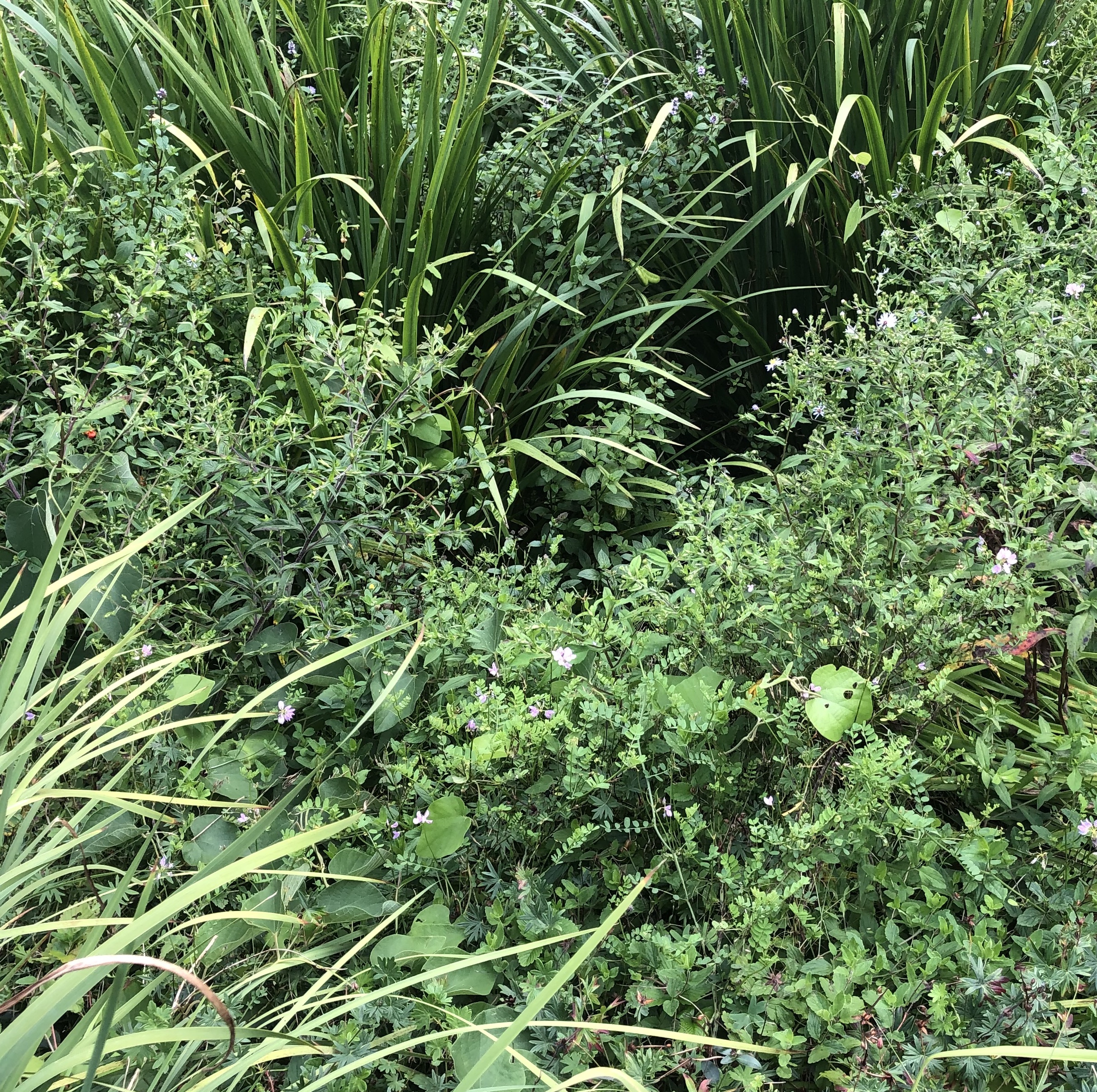
Weeding.  I’m ignoring the crown vetch, the wayward Dutchman’s Pipe, the horse mint, the ubiquitous Michaelmas daisies, and invasive black willow shoots that will be trees by next year. (Forget the Japanese knotweed.) They taunt me when the soil is moist like it is today; they’d be so easy to pull.  But the closest I’ve come to doing yard work is tying strands of day-glow orange yarn around some transplanted saplings.  The hope is that the weed-whacker will skirt them. If they do survive the winter, I’ll have a bank of white iris along the stream. This will be my defensive wall against the onslaught of weeds that love the watery edge of the lawn. Much easier than pulling them out. 

Needless to say, I’m not doing a lot of other things, say, skydiving, open heart surgery, or robbing a bank. Though they don’t count; they’re beyond pale of imagining, at least in this life. It is tempting to think of what I might be doing if things had gone differently. Think Run, Lola, Run. But unlike the operations of chance that obsess Tod Tykwer, grieving, fretting, exercising, and weeding aren’t alternate states of being and doing. They are just deferred.

Packing

The only thing more satisfying than writing a packing list is the packing itself. But to be fully enjoyed, packing has to be approached in stages – no matter whether it’s a train trip to Rhode Island or a flight to Warsaw or a bus to New Jersey. I can’t even start a list without mulling over the contingencies.

They say it’s going to rain there. Should I take ‘them’ seriously?
It could drop below freezing, but only late at night. But will I be out then?
There is a pool. Will I really use it?
I might need a hat for the sun. But will I wear one?  Hats are conspicuous.
Dress shoes? Do I ever wear them? Or are they just wishful thinking?
Earrings? One pair should be enough, no? But they don’t take up space.

Implicit in every question is an artifact: an umbrella, sweater, swimsuit, a wide-brimmed hat, and a pair black suede pumps. They all go on the list with the usual suspects: pants, tops, a tunic or dress(es), tights and socks (not in summer), a scarf, undergarments, pj’s, toiletries, reading material, charging cords, and meds. If it’s a professional gig, also computer and printed notes. If it’s to stay with friends, a house present that doesn’t weigh more than a bottle of wine. Winnowing sartorial options while repeatedly checking a weather app becomes a game – a way of trying to predict the future in a box-on-wheels, and for the shortest trips, a handbag. (Mine is a portable filing cabinet. Very gratifying.) The goal is to cross out all but the essential items and still be presentable, and maybe a bit better than that.  So several lists are made. My pre-travel-self rationalizes it as a necessary. Or, at the least, an edifying form of procrastination. Really, it’s a way to start leaving. The only risk is that the anticipation might turn out to be better than the going. (Incidentally, the rules of packing don’t apply to the return trip, for obvious reasons. The destination has no unknowns.)

This ritual of list-making-editing is not simply a symptom of a traveler’s latent OCD. It’s dictated by the first rule of travel: Never check luggage. Fold, roll,  stack, wedge, fill in the corners of the suitcase, strap it all in, and if need be, sit on it until the contents are as flat as origami. Unless I’m gone for more than a month, I would rather use a hotel’s laundry and hand-wash the unmentionables myself. That way there’s no lost luggage; no waiting around a carousel when I just want to be home. But I’ve not even left, yet. How did that happen?

Lists and their uses

  1. Write libraries about acquiring Thinking Design through Literature
  2. Check with the board of elections to be sure I’m still registered to vote in Manhattan
  3. Pick up necklace from Chris in midtown
  4. Buy ribbon to cover base of Julianna’s wedding cake
  5. Get stuff for BLT’s (dinner)
  6. Replace AA batteries 
  7. Have lunch in midtown with Joan
  8. Follow up on HighGround archive proposal; call Kathy and Tucker
  9. Clean desk
  10. Pack books for country

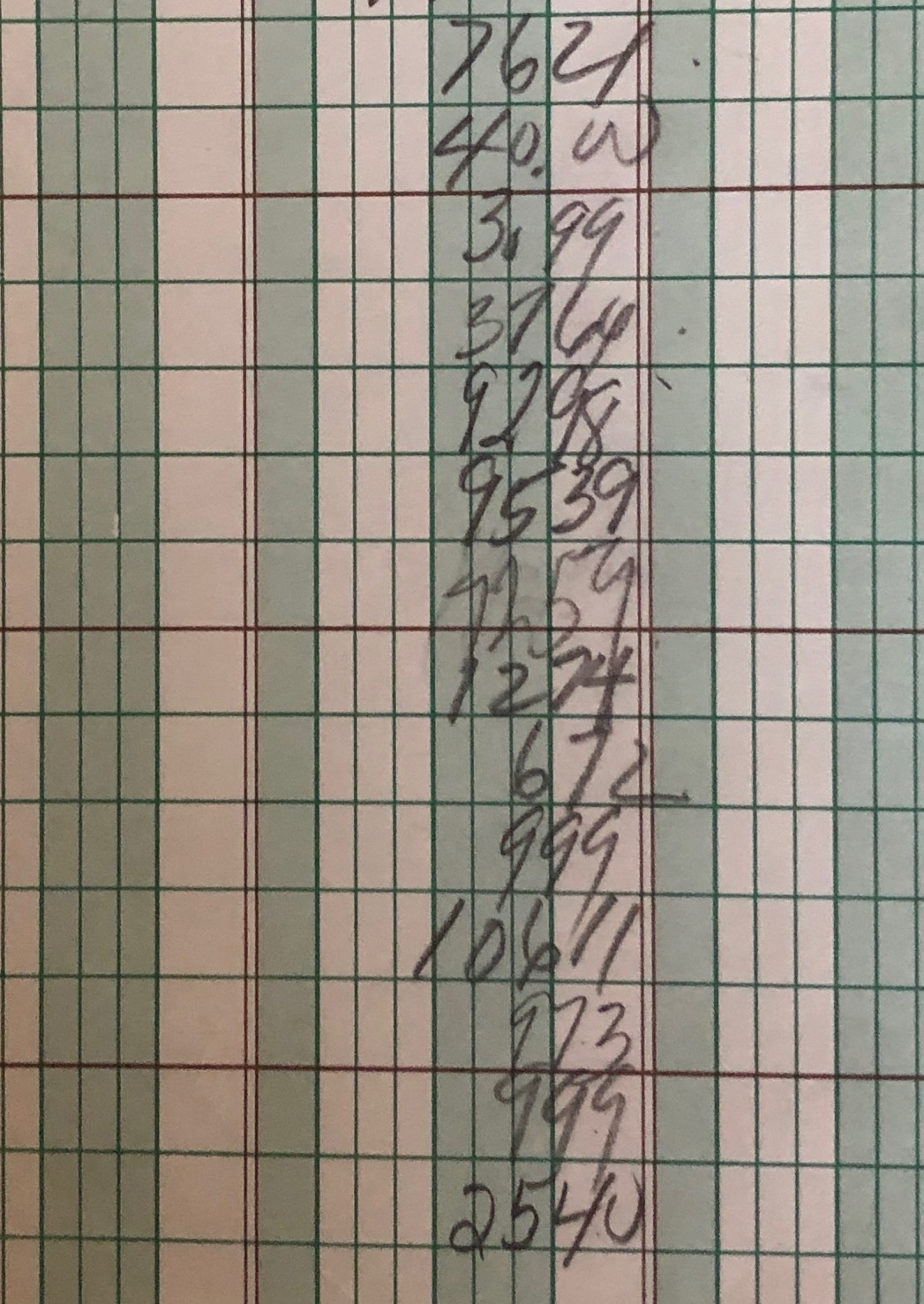
This is today’s (much-cleaned-up) list of things to do.  It’s the type of list made to assure the list-maker that she’s aiming to be productive even when she’s not working on a dedicated project – a book, a lecture, or research for one or the other.  As lists go, however, it isn’t nearly as interesting as lists of things done. I have some of those, too. Like the list of books I’ve read – or at least those I can remember.  Also, lists that most people would call budgets, made to show not only what I’ve spent but, more importantly for me, what I’ve spent it on, what I’ve done. This is the truly gratifying aspect of tax season: seeing last year’s exchanges penciled in longhand on graph paper.

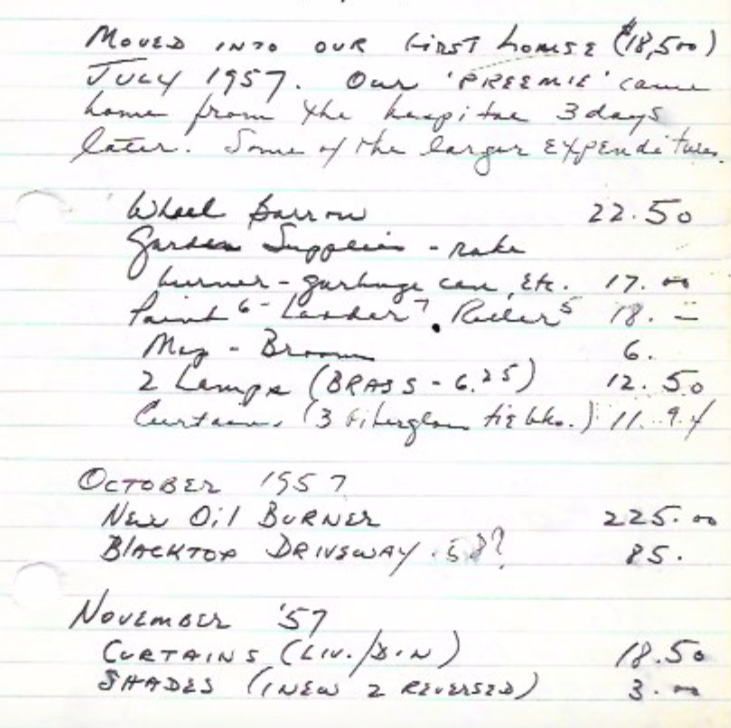
My favorite lists, however, are those that are continuous, lists that speak to lives not just days. My mother specialized in these. There was her list of household purchases, which included virtually everything she bought – dishes, rugs, bikes, cars, even the house itself – between 1957 and 2018, the year she died.  

She also kept a list of all the objects she accrued from her work at estate sales. Quite considerable, given she didn’t work on a regular schedule, this particular list has an added dimension. It doesn’t just record what she paid but it also notes who each item was purchased for – virtually everything is annotated with one of our names. A detailed record of maternal generosity and prudence, this list leaves no monies unaccounted for and hardly any wasted space on the page.  Paper had its value too. 

There is yet a third species in my mother’s warehouse of lists, one that we only were able to fully appreciate after her death. A few weeks after she was buried, my three sisters, my brother, and I decided we would start the task of clearing out her condo.  Most of the decisions had been made with her long beforehand. My mother couldn’t bear the thought that things that were of value, and valuable to her, might not find another home and guardian. (In the spirit of itemization, I should note that among those things were my grandmother’s secretary, a hammered copper bowl that was a wedding present, an Arts and Crafts bookcase she got at a house sale, and her china and her silver, only purchased years after their wedding when they could afford it.) 

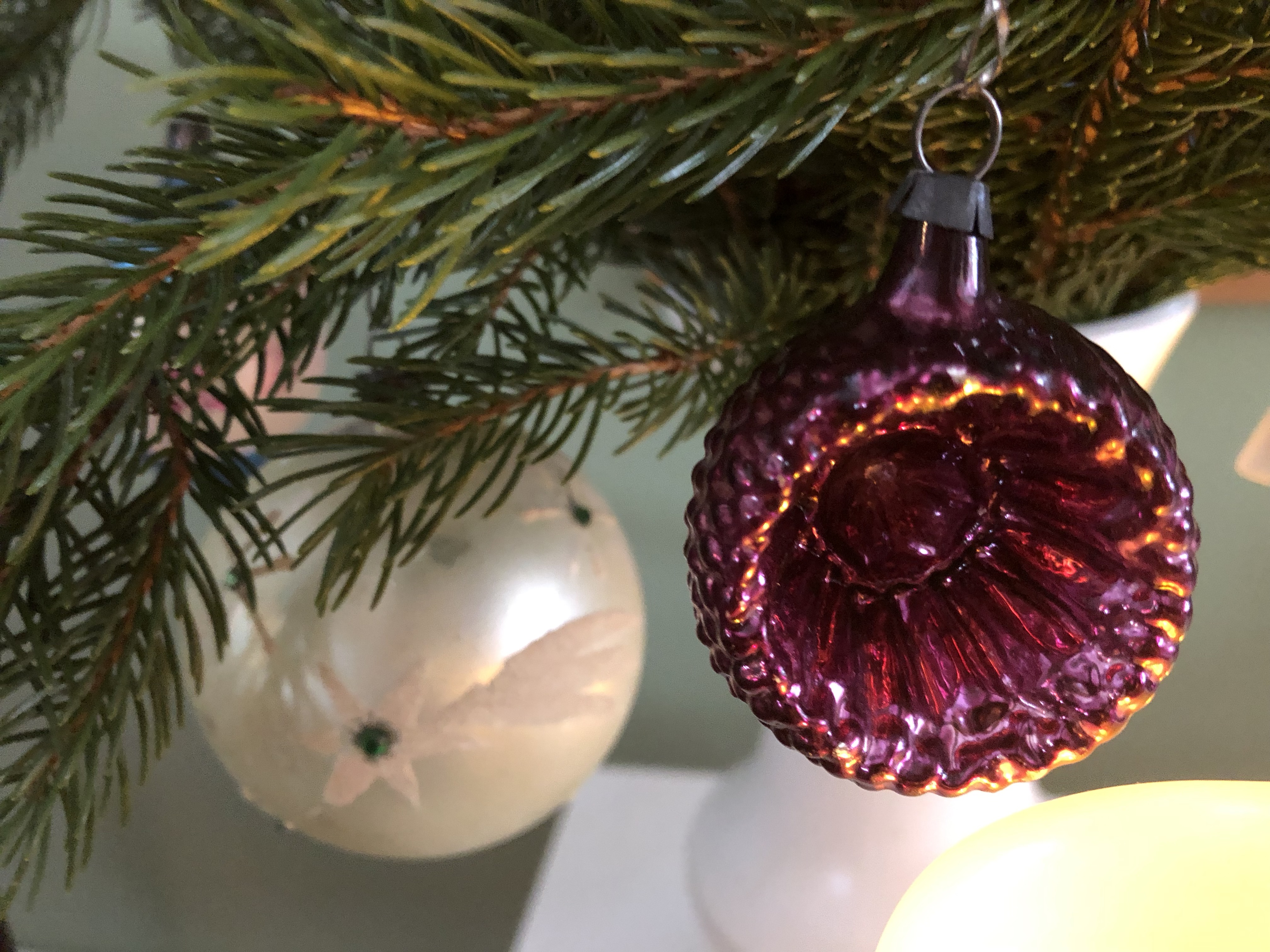
In any case, we decided to start small.  It was early December and divvying up her Christmas ornaments made sense. What I hadn’t seen before was her ornament list. It was a reminder (in case we could have possibly forgotten) which of us gave her the wooden rabbit (her maiden name was Hare), the raffia angel, the Nutcracker, or the drum. You could say that we were looking at a will of sorts, since the presumption was that we would take what we gave.  But in her handwriting, it felt like something else. This was a reciprocal list, made to be used once by its maker and once by each of us.

Friends have asked me why my mother was so thorough.  Money was always to be husbanded in a family with five children, true.  Apart from that, I believe the lists testified to managerial skills that could otherwise have run a company and a family. I also believe that her list making gave material substance to a life marked by doing, not sitting still.

Composing lists is no different than making any other object, in the sense that it requires taking a break from the to-ing and fro-ing that govern our days – a respite my mother surely needed. Most satisfying to her daughter, though, is that the list itself becomes an object of contemplation after the fact. My eye follows the cursive of her handwriting and sees such care in those lines. They assure me that lists of things ‘done,’ are not about the past but about things worth remembering now – including the lists themselves.

Designing from infinity to multiplicity

Katsuru path

The human mind has a mysterious mechanism whereby we are convinced that that particular stone is always the same stone, even though its image – at the slightest movement of our gaze – changes shape, dimensions, colour, outlines. Every single frame of the universe breaks up into an infinite multiplicity: all you have to do is go round this low stone lantern and it turns into an infinity of stone lanterns; this fret-worked polyhedron of stone, marked with lichens, becomes doubled and quadrupled and sextupled, turning into a totally different object depending on which side you look at it from, on whether you are approaching or leaving. 

Italo Calvino, “The Thousand Gardens”1

Clearly I’m not done with (and never will be) Calvino’s Collection of Sand.  While describing his walk around Kyoto’s 17th-century Katsura Imperial Villa in “The Thousand Gardens,” Calvino acts as its resident phenomenologist. At the same time, with a literary slight of hand (or is it flight of head?) he also brings to mind Jorge Luis Borges’ “Funes the Memorious.”2 No matter that Borges’ story is set in Uruguay.

As it happens, Borges’ protagonist, the eponymous Funes, comes to the same recognition of an “infinite multiplicity” that Calvino describes in the passage above – but purely by dint of accident. A fall from a horse similarly changes the way Funes sees the world. In fact, he’s unable to forget anything he experiences. His brain is awash with the detritus of unfiltered sensations. Funes can only describe each thing (each event might be more accurate) as he sees it and feels it.

In contrast, to Borges’ diagnostic tale in which there is no cure for poor Funes, Calvino’s is corrective. He transcends the ground around Katsura while never looking away from it. He counts the number of slabs that make up the path at the Villa and finds there are 1,716.  It is these specific stones that afford the visitor 1,716 perspectives out of the incalculable possibilities. Now infinity is tapered to multiplicity and Calvino finds he “can master [the garden] without being overcome.”3 The perspectives opened up by each carefully positioned slab are duly credited to the garden’s designer. It is the designer’s decisions that alleviate his Borgesian anguish.  (“Anguish” is, in fact, the word Calvino chooses to describe the affect of too-much.)

Here is the essay’s true gift to those concerned about the integrity of designing in the age of design thinking sans making. By collapsing the 17th-century into his present (roughly 1984), Calvino locates the essence of the act of designing, that being to edit. (Needless to say, editing doesn’t necessarily require subtraction; it can also be a matter of addition, of proposing options.) No matter the strategy, Calvino confirms that design, at its essence, contends with the disease of sensations that afflicts Ireneo Funes. It is easy to forget how disoriented we would be without paths. We’d be lost in undifferentiated space.  

  1. “The Thousand Gardens” in Italo Calvino. Collection of Sand. [1984] Boston, New York: Houghton Mifflin Harcourt, 2002, 170.
  2. I am indebted to philosopher James Dodd for introducing me to Borges’ story as a ‘way into’ phenomenology. Neither Borges’ or Calvino define the concept, nor will I. Their prose is its best approximation short of reading Dodd (and Husserl before him.)
  3. Ibid., Calvino 171.

Almost t/here

Sometimes we feel such sympathy with certain writers as to believe they are speaking for us, even stealing our thoughts. It is just this sensation that overtook me when I read Italo Calvino’s “In Memory of Roland Barthes” in Collections of Sand and encountered two of the best literary minds conflated into one.  One that I recognized as almost mine.  (By ‘one,’ I mean both the experiences they recount and the experience of their words.)

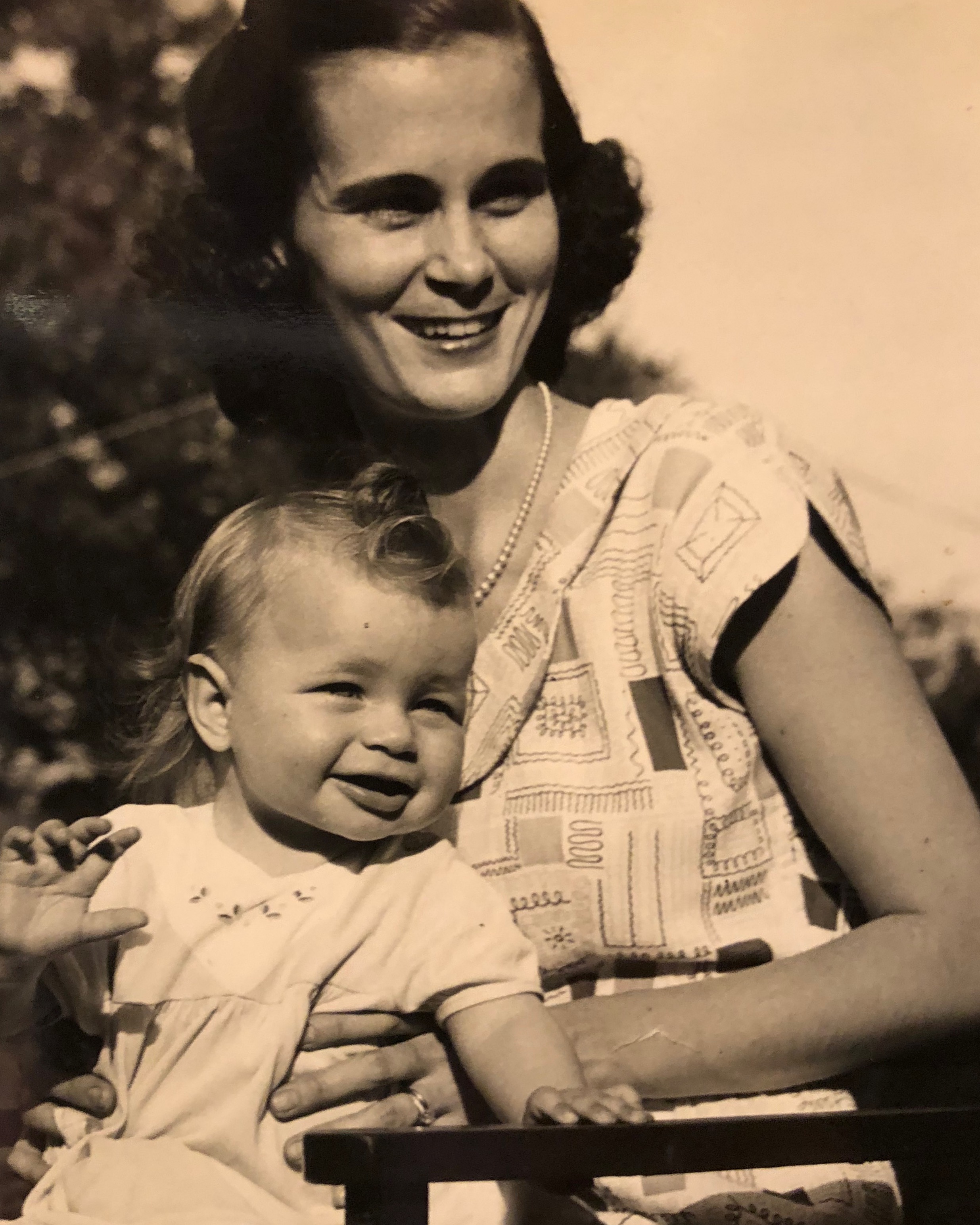
Case in point is Calvino’s speculation that Barthes started writing Camera Lucida while reflecting on photographs “of his recently dead mother … in an impossible pursuit of [her] presence.”  When looking at (photos of) my own recently deceased mother, I am always stymied by her presence-absence. I try my best to crawl into those pictures to no avail, except for the reassuring confirmation of her having-been.

Keeping company with the likes of Calvino and Barthes fosters delusions (or is it an illusion, in the phenomenological sense?) of another sort: a sense of mutuality. I know full well that, as Philip Lopate reminds us in The Personal Essay, the very purpose of their work is to “elucidate a more widespread human trait and make readers feel a little less lonely and freakish.” They do.  But Calvino and Barthes (and countless others, not to mention Lopate, himself) also compel this reader to write, albeit as a writer working in a microcosm.  (Is it possible to be a ‘writer,’ if you don’t associate with writers?)  I take comfort in the fact that Andrea Camilleri who died just last month (he of the Commissario Montalbano series and more literary fables) didn’t begin to write prodigiously until he was 67 (though, admittedly, he wasn’t a literary hermit before that). At 69, I’m only two years behind; socially, it’s another matter.

Woven window


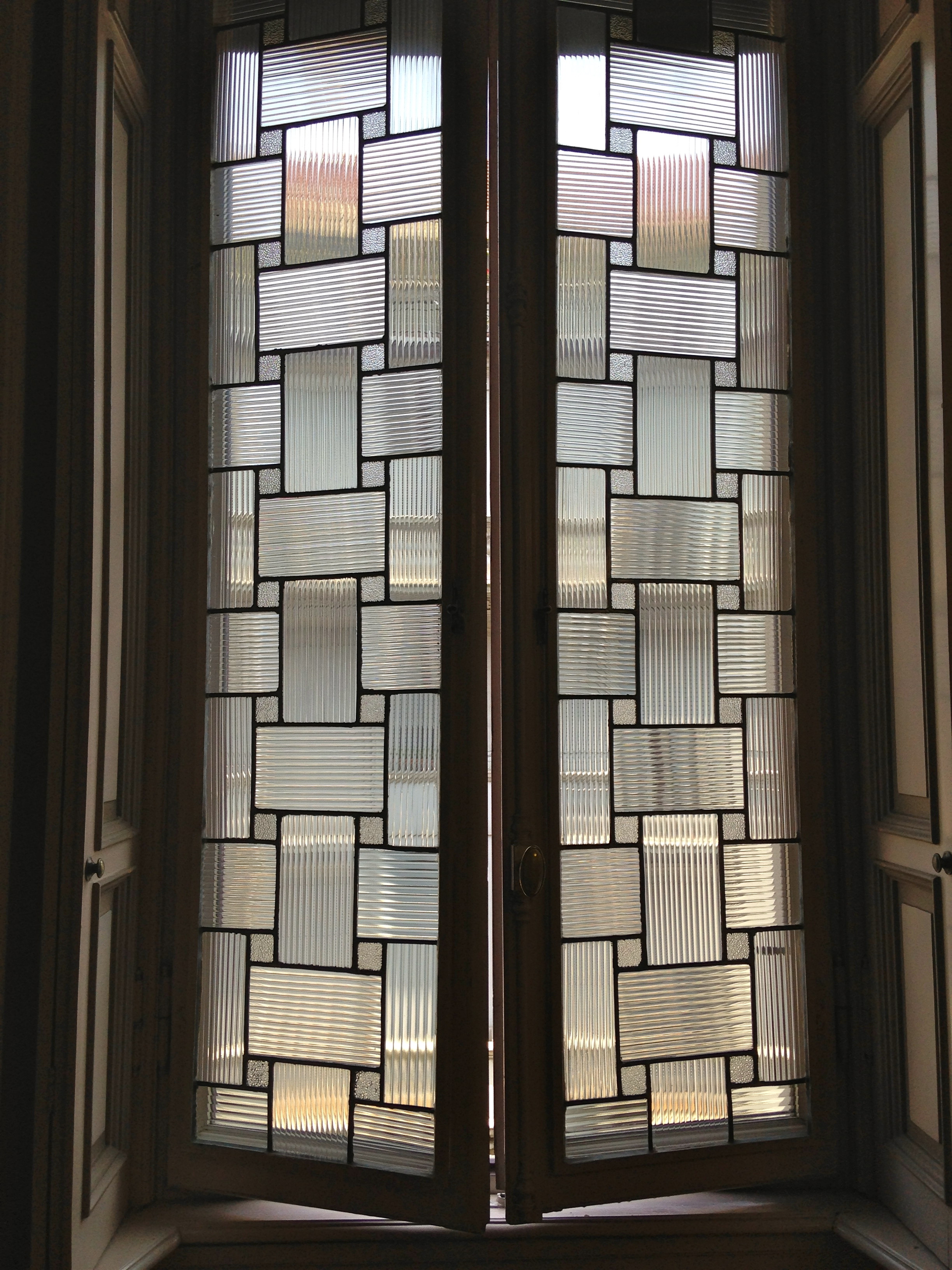
Without a doubt, this is the most beautiful window I have ever seen, more beautiful than the gem-like stained glass at Sainte-Chapelle in Paris or the wavy glass walls of Rem Koolhaas’s Casa da Musica in Porto, Portugal. Though to be fair, this window has more in common with the latter, as it is both curtain and glass.1 Except that where Koolhaas’s wavy window alludes to the trope of the theater curtain, Piero Portaluppi’s ‘woven’ glass panes, each with its own narrow pleats, pays its respect to the curtain fabric, itself.

Warp and weft, defined by black mullions, are collapsed on the same plane, in a paradoxical tension. The taut shallow space where the window wavers is one that usually requires a magnifying glass to see. (That is, unless you are a weaver, knitter, or lacemaker, yourself.) In the picture galleries of the Casa-Museo Boschi Di Stefano in Milan where every wall is covered with paintings, Portaluppi’s presence might be hard to detect, but it’s there in the architecture of the textile-window.

1 But not the literal glass-curtain walls pioneered by Gropius and perfected by Shigeru Ban, where the view is a surrogate fabric.

American Faux

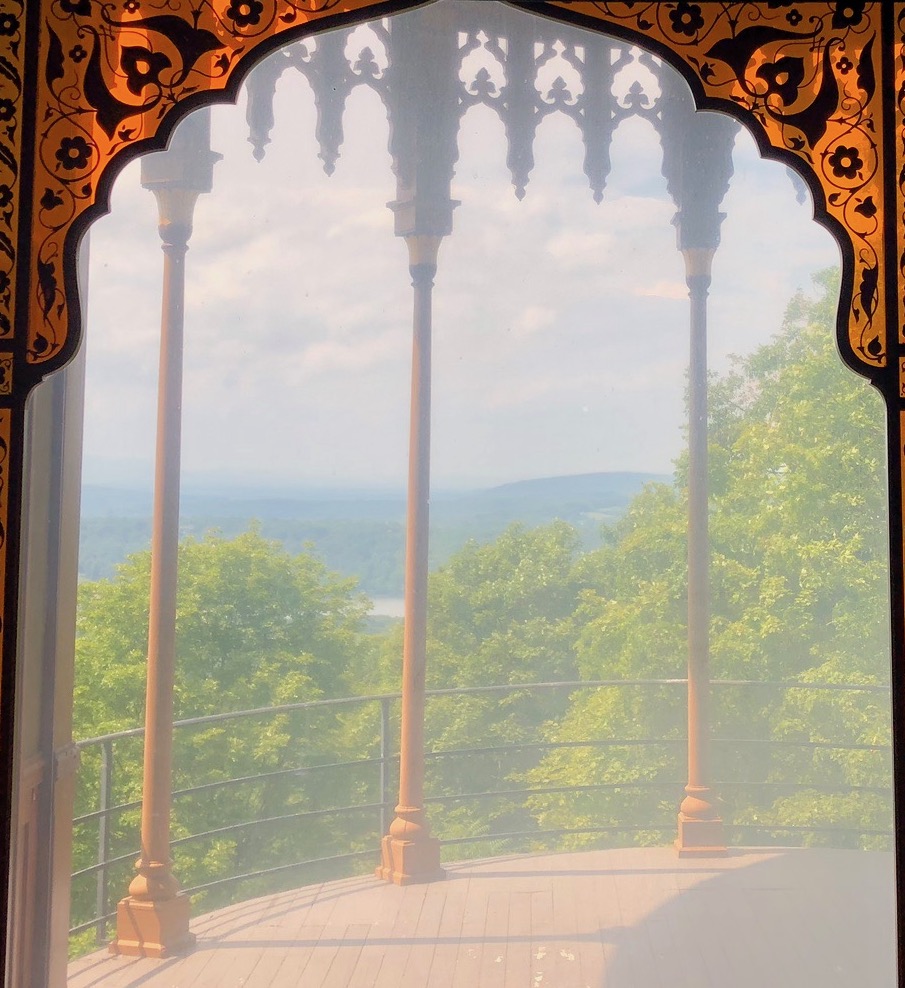
Faux. Fake.  We seem to excel at that, even in the politics of the decorative. The point was driven home by a trip to Olana this week. Frederic Church’s mid-nineteenth century home overlooking the Hudson would be down right crass but for its somber palette inside and out. (Lugubrious may be more accurate.) Stenciled ornament substitutes for carving; cut paper (like katagami) is sandwiched between glass panes to look like wrought iron. Even the brass stair railing with its regular nodal rings hints at (industrialized) bamboo. The authenticity of the Churches’ acquisitions—Syrian armor, French (maybe Belgian?) tapestry, pre-Colombian fragments, and tarnished brass mosque lamps—looks suspicious in the company of so much ersatz.  Even the view of the Hudson (which now includes the very 20thcentury Rip Van Winkle Bridge) seems like a painting.  A fabrication in every sense of the word, Olana is simultaneously a love affair with and cannibalization of Arabic, Persian, Turkish, Indian, Chinese, and Japanese motifs—themselves distillations from an undifferentiated antiquity. Of course, that antiquity is not Greco-Roman, but the all-encompassing ‘Exotic.’ (Funny to think of making a pilgrimage of an hour’s plus drive to see an architectural souvenir of a world traveler.)

Curiosity about differences means we’re alert to realms outside our imagined perimeters. But trying to tame that difference—there’s a less salubrious word for that. In any case, it’s instructive to see Olana meticulously restored. It offers a subtly discomforting foil to the undiluted nature of Church’s landscape paintings—paintings that attempt to penetrate their subjects where the house glosses over them. It is a poor-man’s Alhambra as stylized as a tail-fin on a Cadillac. Yet, Olana never succumbs to parody. In the looseness of its borrowings, this decorated shed is a reminder of America’s affinities to the hybrid—which, on our good days, extends well beyond the politics of ornament.